300余名Boston Dynamics员工请愿阻止向ICE出售Spot机器狗,管理层坚持合同
ICE plan to buy robot dogs spurs protest from hundreds of Boston Dynamics employees
波士顿动力超过300名员工(约占约1400名员工的五分之一)签署请愿,要求叫停美国国土安全部向Radeco授予的130万美元合同,该合同为ICE提供4台改装版Spot机器人(命名为Cerberus),用于探测辐射、毒气泄漏和爆炸物威胁。公司管理层拒绝叫停,援引禁止武器化条款并强调机器人不会武器化,但员工担忧与ICE的关联将影响招聘和团队留任。
Privacy Center
Currently, only residents from GDPR countries and certain US states can opt out of Tracking Technologies through our Consent Management Platform. Additional options regarding these technologies may be available on your device, browser, or through industry options like AdChoices. Please see our Privacy Policy for more information.
Social Media
- On
These cookies are set by a range of social media services that we have added to the site to enable you to share our content with your friends and networks. They are capable of tracking your browser across other sites and building up a profile of your interests. This may impact the content and messages you see on other websites you visit. If you do not allow these cookies you may not be able to use or see these sharing tools.
Essential
- On
This website uses essential cookies and services to enable core website features and provide a seamless user experience. These cookies and services are used to facilitate features such as navigation, remember user preferences, and ensure the security of the website.
Targeted
- On
These cookies may be set through our site by our advertising partners. They may be used by those companies to build a profile of your interests and show you relevant adverts on other sites. They do not store directly personal information, but are based on uniquely identifying your browser and internet device. If you do not allow these cookies, you will experience less targeted advertising.
Performance
- On
These cookies allow us to count visits and traffic sources so we can measure and improve the performance of our site. They help us to know which pages are the most and least popular and see how visitors move around the site. All information these cookies collect is aggregated and therefore anonymous. If you do not allow these cookies we will not know when you have visited our site, and will not be able to monitor its performance.
Functional
- On
This website uses functional cookies and services to remember your preferences and choices, such as language preferences, font sizes, region selections, and customized layouts. They enable this website to offer enhanced and personalized functionalities.
Audience Measurement
- On
We use audience measurement cookies in order to carry out aggregated traffic measurement and generate performance statistics essential for the proper functioning of the site and the provision of its content (for example to measure performance, to detect navigation problems, to optimization technical performance or ergonomics, to estimate server power needed and to analyse content performance). The use of these cookies is strictly limited to measuring the site's audience. These cookies do not allow the tracking of navigation on other websites and the data collected is not combined or shared with third parties. You can refuse the use of this cookie by switching off the slider to the right.
OK
English Deutsch Español Français Italiano 日本語 繁體中文
en
Skip to contentArs Technica home
Sections
Story text
Size Width * Links
- Subscribers only
Learn more
Pin to story
Theme
- HyperLight
- Day & Night
- Dark
- System
Sign In
Sign in dialog...
Sign in
See Spot, run?
Boston Dynamics employees want to block sale of robot dogs to ICE
US robotics company stands by ICE deal as more than 300 employees warn of risk.
Jeremy Hsu – Oct 26, 2026 6:50 PM|0
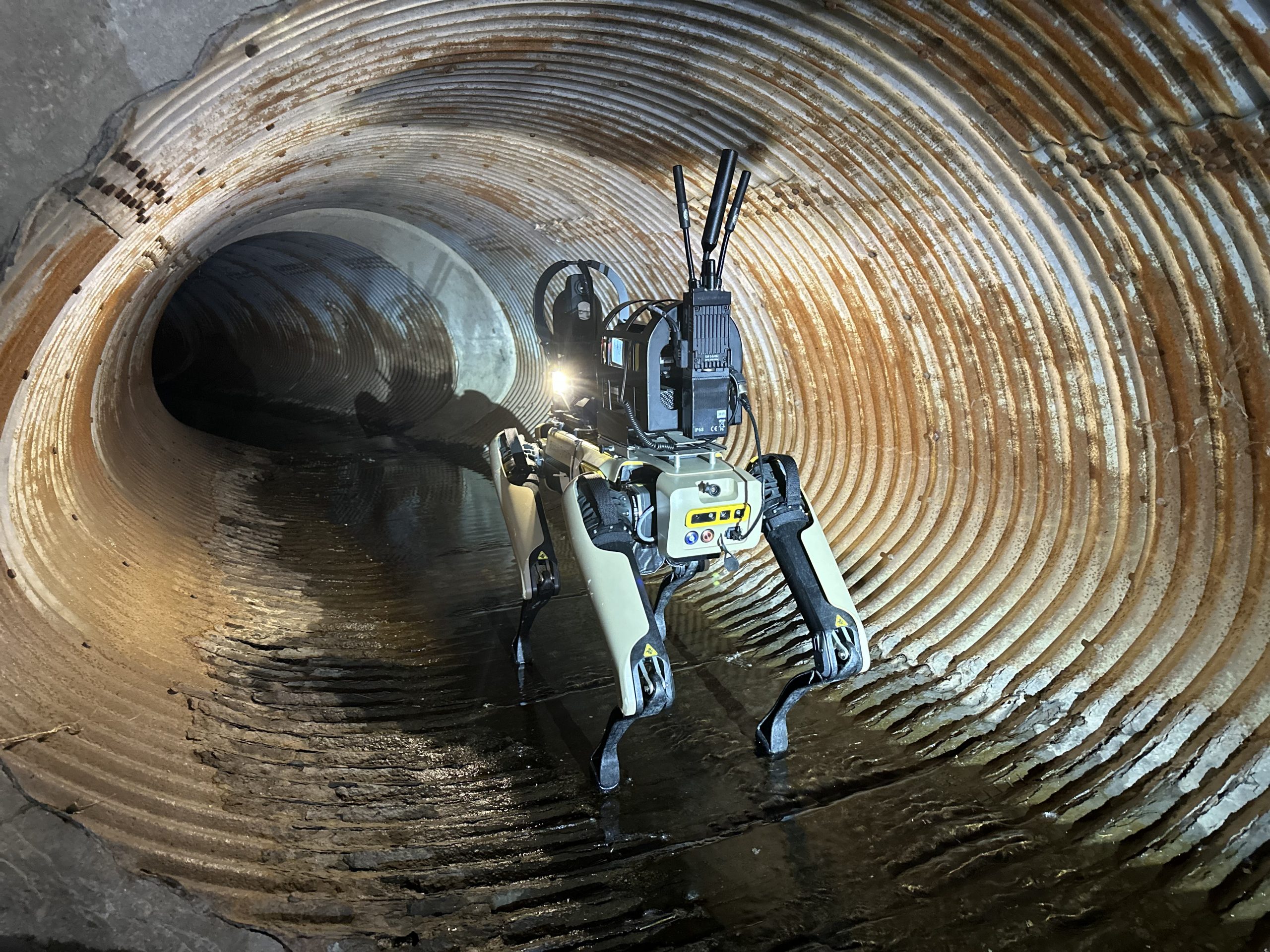
The Cerberus quadruped robot sold by Radeco is a modified version of the Boston Dynamics robot Spot upgraded with military-grade equipment and designed to detect dangerous substances. Credit: Radeco
The Cerberus quadruped robot sold by Radeco is a modified version of the Boston Dynamics robot Spot upgraded with military-grade equipment and designed to detect dangerous substances. Credit: Radeco
Text settings
Story text
Size Width * Links
- Subscribers only
Learn more
Minimize to nav
Hundreds of employees at the US robotics firm Boston Dynamics signed a petition calling for executives to halt a sale of the company’s robot dogs to US Immigrations and Customs Enforcement—but executives stood by the deal, while saying the robots would not be weaponized.
On September 25, the Department of Homeland Security contract awarded $1.3 million to a Connecticut company called Radeco to provide ICE with modified versions of Boston Dynamics’ quadruped robots. But Boston Dynamics workers sent the petition letter with more than 300 signatures—half of them anonymous—to the company’s executives in early September and shared copies with The Boston Globe and WBUR public radio station.
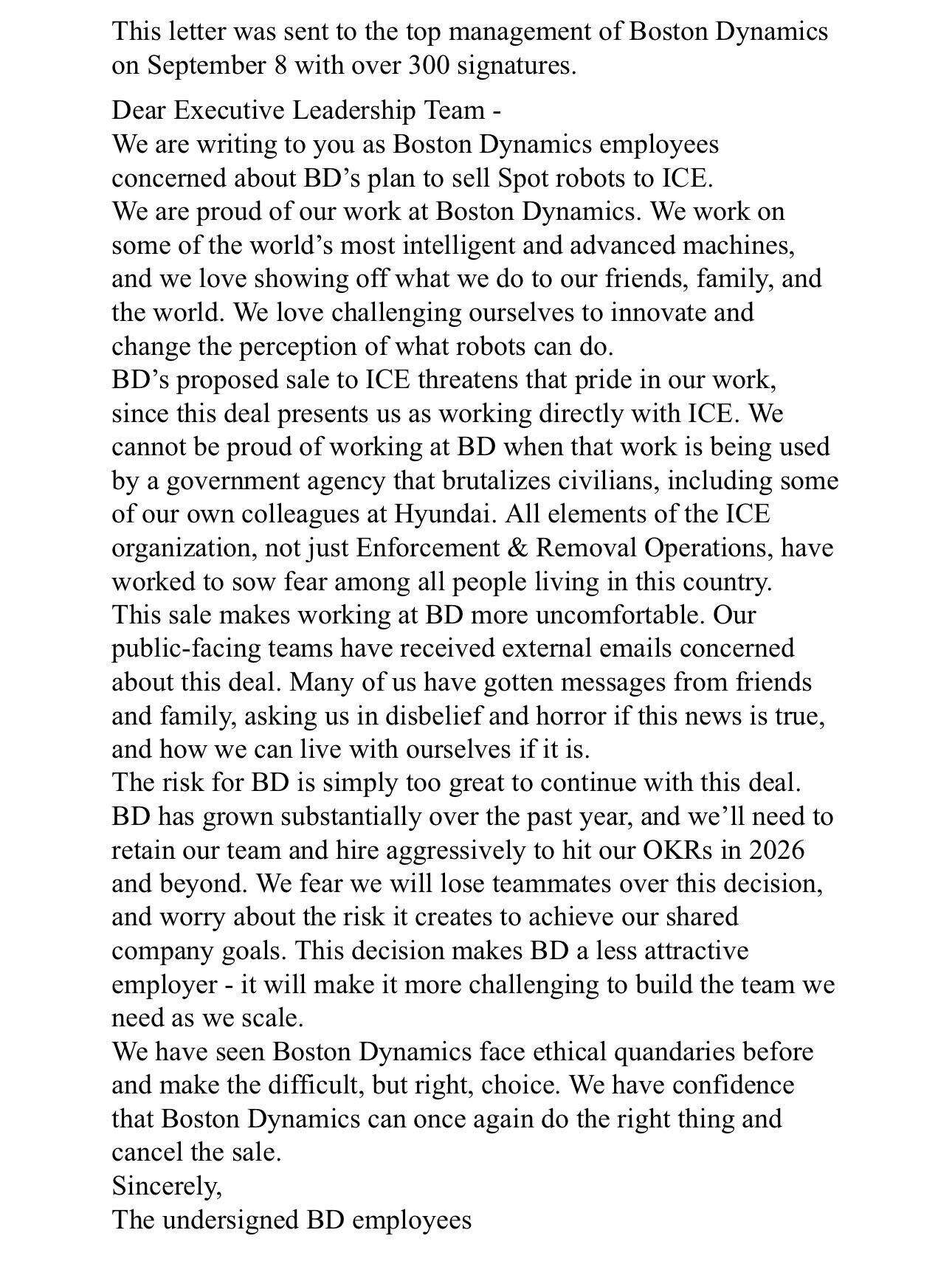
“Many of us have gotten messages from friends and family, asking us in disbelief and horror if this news is true, and how we can live with ourselves if it is,” according to the petition. “The risk for Boston Dynamics is simply too great to continue with this deal.”
The petition described the signatories as employees who normally “love showing off what we do to our friends, family and the world” and who “love challenging ourselves to innovate and change the perception of what robots can do.” The 300 signatures come out of a total Boston Dynamics workforce of approximately 1,400 people.
Spot’s Cerberus upgrade
The ICE contract covers the purchase of four Boston Dynamics Spot robots that were modified by Radeco to be marketed as a robot platform named Cerberus. The contract describes these Cerberus robots as being intended to “detect radiation, toxic gas leaks and explosive threats in urban environments or disaster zones,” along with enabling other remote observation and inspection missions.
Ars Video
How Lighting Design In The Callisto Protocol Elevates The Horror
A centerpiece of the upgraded robot is an oxygen sensor that is intended to “ensure the air quality is breathable when personnel are placed in confined spaces such as tunnels.” The Cerberus robot dog also has a camera equipped with 30-times zoom capability, 360-degree cameras, and infrared thermal imaging.
The Cerberus robot dog would come with an optional Spot robotic arm that enables it to manipulate objects and open doors, along with providing additional camera views when extended. The ICE contract describes the robot as being generally capable of navigating complex industrial environments on its own and executing “repeatable autonomous missions with minimal human intervention.”
Such a purchase was justified in the ICE contract as supporting the Homeland Security Task Forces’ mission to carry out “counter-illicit cross-border tunnel operations” and dismantling “cross-border human smuggling and trafficking networks” being conducted by “criminal cartels, foreign gangs and transnational criminal organizations throughout the United States.”
“Spot robots are tools that help keep people out of harm’s way,” a Boston Dynamics spokesperson told Ars in a statement. “Regardless of any political implications or personal feelings about the organizations involved, if our robot can help keep people safe, we believe it should.”
From fighting transnational crime to deportations
Boston Dynamics has also emphasized that the robots would primarily be used by ICE’s Homeland Security Investigations unit that is focused on combating transnational criminal organizations, according to WBUR.
However, the Brennan Center for Justice has documented the Homeland Security Investigations unit as frequently being involved in deporting undocumented workers and conducting workplace raids during the first administration of President Donald Trump. These operations occurred between 2018 and 2021, before being halted by US Secretary of Homeland Security Alejandro Mayorkas early in the term of President Joe Biden.
During Trump’s second term that began in January 2025, the Homeland Security Investigations unit once again diverted thousands of agents to immigration enforcement and deportations after one of Trump’s executive orders redefined the unit’s primary mission, according to the Immigration Policy Tracking Project.
The Boston Dynamics employee petition specifically referenced an ICE and Homeland Security Investigations workplace raid that detained 475 primarily South Korean workers at the Hyundai Motor Group Metaplant America facility in Georgia on September 4, 2025. Hyundai Motor Group became the parent company of Boston Dynamics after acquiring the US robotics company in June 2021.
“We cannot be proud of working at Boston Dynamics when that work is being used by a government agency that brutalizes civilians, including some of our own colleagues at Hyundai,” according to the employee petition. “All elements of the ICE organization, not just Enforcement & Removal Operations, have worked to sow fear among all people living in this country.”
That single largest immigration enforcement operation of its kind sparked public outrage in South Korea and led to South Korean leaders questioning the country’s business investments in the United States. However, Hyundai has maintained its operations at the US electric vehicle production at the Metaplant America factory and still plans to deploy thousands of Boston Dynamics’ Atlas humanoid robots starting at its US facilities.
Boston Dynamics says Spot won’t be weaponized
The Boston Dynamics leadership team has stood by the ICE contract with Radeco, which would mainly involve Boston Dynamics providing technical support for the modified robots, according to The Boston Globe.
The company also responded to the employee petition via an email from Amanda McMaster, former interim CEO for Boston Dynamics. That email was obtained and quoted in part by both The Boston Globe and WBUR.
“We believe this decision is in line with our purpose of ethically advancing intelligent machines in service of humanity,” McMaster wrote in her email. She urged workers to “respect and accept this decision, even if you do not agree with it.”
McMaster also pointed to the company’s terms and conditions for sale of the Spot robots that prohibit “intentional use of the Product to harm or intimidate any person or animal, as a weapon, or to enable any weapon.” The company previously signed an open letter opposing the weaponization of “advanced-mobility general-purpose robots.”
The Boston Dynamics spokesperson told Ars that the company has “worked productively” with the Department of Homeland Security and Homeland Security Investigations unit for years, and said the latter have abided by the company’s terms and conditions of sale.
The robotics company said it would also “take immediate action” if any customer misused Spot, although it said “there have been no cases of a customer violating those terms and conditions” while working with the Department of Homeland Security and other “public safety agencies.”
“That would include specific steps like voiding the warranty, refusing all future software updates, terminating their license, taking any appropriate legal action available to us, and likely never selling to that customer again,” said the Boston Dynamics spokesperson.
Future workforce concerns
The Boston Dynamics employee backlash to the ICE contract comes as the company is developing a new advanced robotics and AI facility in Waltham, Massachusetts, near its headquarters. Part of that $100 million project involves creating 1,250 new jobs by 2033, according to a company press release.
The ICE contract represents “a complicated and emotionally charged topic for many people, including some of our own employees,” said the Boston Dynamics spokesperson. “As our company continues to grow at a rapid pace, we will continue welcoming a highly diverse group of employees with views on every side of the social and political spectrum.”
But as Boston Dynamics ramps up its production capabilities and deployment of robots such as Spot and Atlas, the employees who signed the petition expressed concerns that the company’s association with the ICE contract will threaten both workforce hiring and retention.
“We fear we will lose teammates over this decision, and worry about the risk it creates to achieve our shared company goals,” according to the petition. “This decision makes Boston Dynamics a less attractive employer—it will make it more challenging to build the team we need as we scale.”

Jeremy HsuTech Reporter
Jeremy HsuTech Reporter
Jeremy Hsu is a reporter exploring a wide range of topics across deep tech and AI. He has previously written for New Scientist, Scientific American, IEEE Spectrum, Wired, Undark Magazine and MIT Tech Review, among many other publications, about topics such as deepfakes, data centers, drones, battery tech, robotics, and GPS jamming. He also has a Master of Arts in Journalism from NYU, and a bachelor's degree from University of Pennsylvania in History and Sociology of Science, with a minor in English.
Comments
 Loading comments...
Most Read
 1.Ice sheet expansion may have started 2,000 years ago, but we canceled that
- 2.From impulse purchase to pocket studio: The M-Vave FM-1
- 3.NASA updates lander plans for Moon landings, finally solves long-festering Orion issue
- 4.Inside the Pentagon, the pressure is on to find a home for a new spaceport
- 5.Rocket Report: SpaceX says no thanks to military launches; Spanish rocket nearly ready
Customize
Ars Technica has been separating the signal from the noise for over 25 years. With our unique combination of technical savvy and wide-ranging interest in the technological arts and sciences, Ars is the trusted source in a sea of information. After all, you don’t need to know everything, only what’s important.
More from Ars
Contact
Manage Preferences
© 2026 Condé Nast. All rights reserved. Use of and/or registration on any portion of this site constitutes acceptance of our User Agreement and Privacy Policy and Cookie Statement and Ars Technica Addendum and Your California Privacy Rights. Ars Technica may earn compensation on sales from links on this site. Read our affiliate link policy. The material on this site may not be reproduced, distributed, transmitted, cached or otherwise used, except with the prior written permission of Condé Nast. Ad Choices
Sign in dialog...
Sign in


来源:Ars Technica:AI · arstechnica.com