Google 发布 Gemini 4 Carbon,将在 Fairwinds 网络防御计划中分阶段开放
Google announces Gemini 4 Carbon, its latest frontier AI model that you can't use
Google 在发布 Gemini 4 Argon 两周后宣布新一代前沿模型 Gemini 4 Carbon,称其在编码、智能体任务和网络安全方面有提升,但暂不向公众开放。
Manage your consent preferences
If you are a resident of Colorado, Connecticut, Virginia, Utah, Oregon, Texas, Montana, Delaware, Iowa, Nebraska, New Hampshire, and New Jersey, Tennessee, Minnesota, Maryland, Indiana, Kentucky, or Rhode Island you have the right to opt-out of Targeted Advertising, including our “sale” and/or “sharing” of your Personal Information (“Opt-Out”). We and our third-party business partners use Personal Information in accordance with our Privacy Policy to serve advertising believed to be of interest to you (“Targeted Advertising”). If you are a California resident, you also have the right to limit the use and disclosure of your Sensitive Personal information in particular circumstances. Please note that you may need to Opt-Out on each website, mobile app, browser, and device you use, and if you clear your browser cookies, you may need to repeat this process. However, if you have created an account to log in across several of our websites and/or mobile apps, we will make reasonable efforts to apply your Opt-Out request to each of those websites and apps. ◦ To Opt-Out of Targeted Advertising on this site: Move the “Allow Targeted Advertising" toggle below to the left and press “Confirm My Choices”◦ To Opt-Out of other “sales”, including for list rentals, data co-ops, and to limit the use and disclosure of your Sensitive Personal Information: Please email privacy_administration@condenast.com or call 1-877-241-4999.
Essential
- On
These cookies are necessary for the website to function and cannot be switched off in our systems. They are usually only set in response to actions made by you which amount to a request for services, such as setting your privacy preferences, logging in or filling in forms. You can set your browser to block or alert you about these cookies, but some parts of the site will not then work. These cookies do not store any personally identifiable information.
Performance
- On
These cookies allow us to count visits and traffic sources so we can measure and improve the performance of our site. They help us to know which pages are the most and least popular and see how visitors move around the site. All information these cookies collect is aggregated and therefore anonymous. If you do not allow these cookies we will not know when you have visited our site, and will not be able to monitor its performance.
Audience Measurement
- On
We use audience measurement cookies in order to carry out aggregated traffic measurement and generate performance statistics essential for the proper functioning of the site and the provision of its content (for example to measure performance, to detect navigation problems, to optimization technical performance or ergonomics, to estimate server power needed and to analyse content performance). The use of these cookies is strictly limited to measuring the site's audience. These cookies do not allow the tracking of navigation on other websites and the data collected is not combined or shared with third parties. You can refuse the use of this cookie by switching off the slider to the right.
Functional
- On
This website uses functional cookies and services to remember your preferences and choices, such as language preferences, font sizes, region selections, and customized layouts. They enable this website to offer enhanced and personalized functionalities.
Social Media
- Off
These cookies are set by a range of social media services that we have added to the site to enable you to share our content with your friends and networks. They are capable of tracking your browser across other sites and building up a profile of your interests. This may impact the content and messages you see on other websites you visit. If you do not allow these cookies you may not be able to use or see these sharing tools.
Allow Sale/Targeted Advertising?
- On
We may transfer or share your personal information to third parties for the purposes of targeted advertising. You can learn more about what information is used for this purpose in our privacy notice.
Confirm My Choices Reject All Accept All
Skip to contentArs Technica home
Sections
Story text
Size Width * Links
- Subscribers only
Learn more
Pin to story
Theme
- HyperLight
- Day & Night
- Dark
- System
Sign In
Sign in dialog...
Sign in
Making up for lost time
Google announces Gemini 4 Carbon, its latest frontier AI model that you can’t use
Gemini 4 Carbon is essentially a slightly better version of Argon.
Ryan Whitwam – Oct 28, 2026 6:47 PM|0

Credit: Aurich Lawson
Credit: Aurich Lawson
Text settings
Story text
Size Width * Links
- Subscribers only
Learn more
Minimize to nav
It’s almost like Google’s got something to prove after taking a break from releasing new frontier AI models earlier this year. Just two weeks after rolling out Gemini 4 Argon, Google has announced Gemini 4 Carbon. This isn’t the Flash model equivalent we’ve been waiting for but, rather, is an improvement on Argon, and like that model, Google is working on a staged release that could take a while.
Stop me if you’ve heard this one before. Google says its latest AI model reaches a new threshold in coding, agentic tasks, and scientific analysis. It’s so capable, in fact, that Google can’t let you use it just yet.
Gemini 4 Carbon reportedly makes big gains in cybersecurity applications. Google says the model shows a “significant leap” in vulnerability detection, validation, and remediation. Carbon is also apparently twice as likely to generate code that is free of vulnerabilities versus Argon. Meanwhile, the Chrome team claims that Carbon is 10 times better at generating “high-quality” patches compared to non-Google models. Google also notes that Carbon has increased its score by 89 points on WebDev Arena, now ranking at number four on the leaderboard.
Ars Video
How Lighting Design In The Callisto Protocol Elevates The Horror
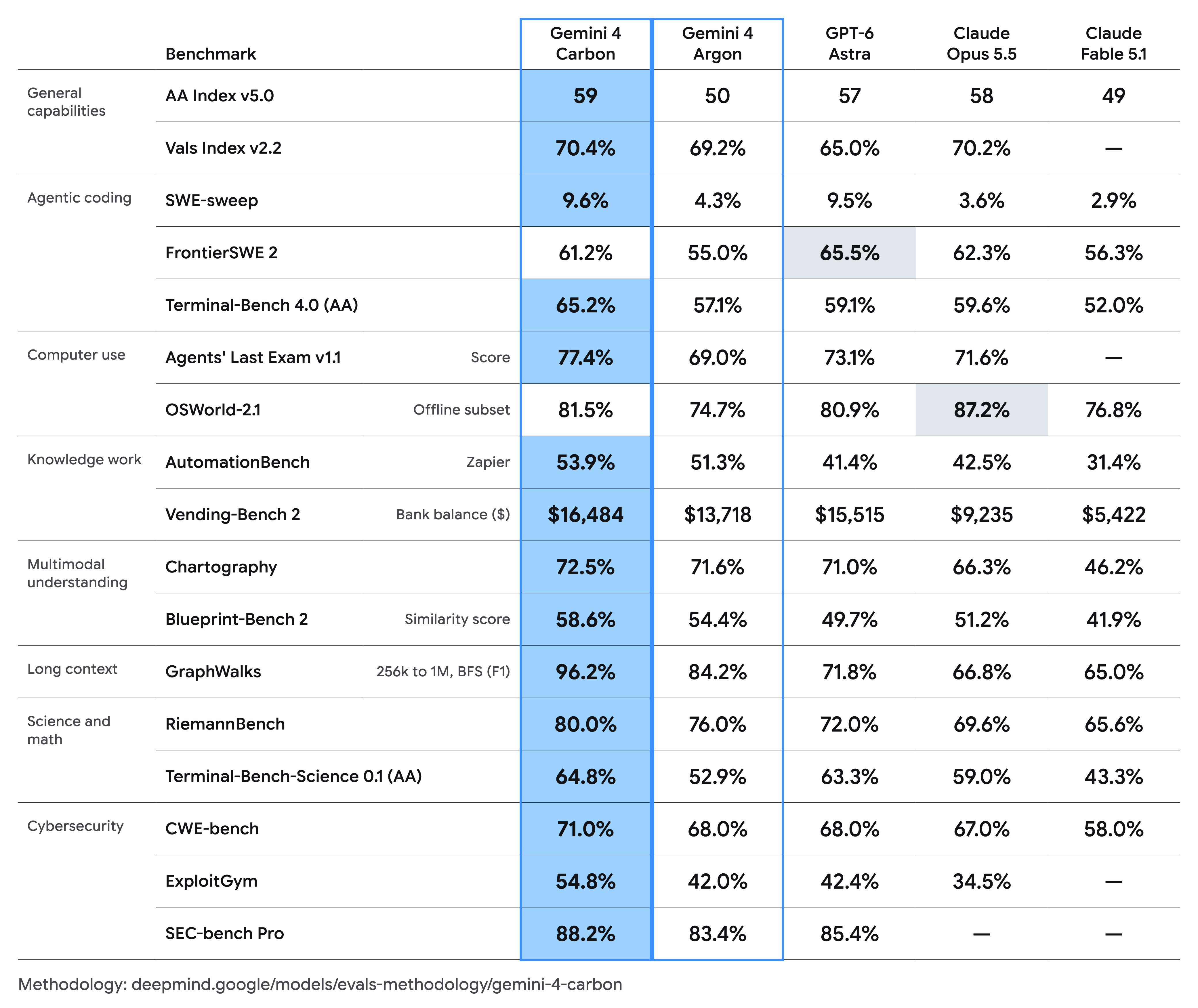
Google has some numbers to support these vague assessments (below), showing Carbon at the top of the charts. Google positions Carbon as a totally new model, but for all we know, it could be a post-training upgrade of Argon. The two models have a lot in common, but Carbon does best Argon by slim margins in every test Google has given it. Its new model also beats GPT-6 Astra, Claude Opus 5.5, and Claude Fable 5.1 in almost every test. Benchmarks don’t tell the whole story, of course, and it’s notable that every frontier model scores in the same neighborhood in these tests. The gap between Carbon and the competition is just a few points.
Credit: Google
Credit: Google
By Google’s reckoning, Carbon is the most capable frontier AI model right now, and its improved capabilities come with more rigorous safeguards. In the Grey Swan evaluation, Carbon resisted every attempted prompt-injection attack. That 0 percent score is better than Argon (0.7 percent), Opus 5.5 (1 percent), and GPT-6 Astra (8.5 percent).
The release plans for Gemini 4 Carbon mirror those for Argon. According to Google, the model’s strong performance in agentic coding and cybersecurity means that it has to take a “deliberative approach.” The company is working within the voluntary testing framework established by the US government, and it plans to roll the model out through its Fairwinds cyber defense program once that’s done. Google does not make any promises about the timeline for a wide release of Gemini 4 Carbon, but if it’s anything like Argon, the model could be available in a couple of weeks.
Carbon will probably arrive first for AI Ultra subscribers and developers using the Gemini API. Like Argon, Google will temporarily offer a discounted API rate of $2 per million input tokens and $10 per million output tokens. That price will double once the introductory period expires. Argon’s discounted rates are only good through the end of November, but Google doesn’t specify a date for Carbon. We’ve asked for details and will update this article when and if Google provides them.

Ryan WhitwamSenior Technology Reporter
Ryan WhitwamSenior Technology Reporter
Ryan Whitwam is a senior technology reporter at Ars Technica, covering the ways Google, AI, and mobile technology continue to change the world. Over his 20-year career, he's written for Android Police, ExtremeTech, Wirecutter, NY Times, and more. He has reviewed more phones than most people will ever own. You can follow him on Bluesky, where you will see photos of his dozens of mechanical keyboards.
Comments
 Loading comments...
Most Read
 1.China's top-secret spaceplane can't hide in low-Earth orbit
- 2.Code-execution flaw in UEFI firmware affects most servers on planet Earth
- 3.Highway thieves are spoofing GPS to steal millions in data center-bound cargo
- 4.Anthropic IPO warns its AI could blackmail people, become sentient, end humanity
- 5.Apple refreshes the iMac, entry-level MacBook Pro with the M6 chip
Customize
Ars Technica has been separating the signal from the noise for over 25 years. With our unique combination of technical savvy and wide-ranging interest in the technological arts and sciences, Ars is the trusted source in a sea of information. After all, you don’t need to know everything, only what’s important.
More from Ars
Contact
Manage Preferences
© 2026 Condé Nast. All rights reserved. Use of and/or registration on any portion of this site constitutes acceptance of our User Agreement and Privacy Policy and Cookie Statement and Ars Technica Addendum and Your California Privacy Rights. Ars Technica may earn compensation on sales from links on this site. Read our affiliate link policy. The material on this site may not be reproduced, distributed, transmitted, cached or otherwise used, except with the prior written permission of Condé Nast. Ad Choices
Sign in dialog...
Sign in


来源:Ars Technica:AI · arstechnica.com