Timothy B. Lee 用机器人学 sim-to-real gap 概念解释前沿模型能力的参差
This robotics concept helps explain the jaggedness of frontier capabilities
Understanding AI 作者 Timothy B. Lee 撰文,借用机器人学中模拟与真实之间的差距(sim-to-real gap)解释为何前沿模型在编程、数学、网络安全进展显著,却难以快速改造律师、建筑等其他职业。
The last year has seen incredible progress in model capabilities in certain domains — most notably programming, mathematics, and cybersecurity. Yet the real-world impact of these breakthroughs has been surprisingly modest — especially outside of those professions.
Lawyers, architects, salespeople, college professors, and others are certainly using AI models in their work, but AI models don’t seem close to transforming those professions the way they seem to be transforming mathematics and computer programming. And even in the software industry, we’re not seeing the kind of mass unemployment many people expected we would see once AI models reached human capabilities.
A big question is why — and whether the impact might grow in the next few months or years. Many people expect massive AI-driven disruptions to begin hitting other professions in 2028 or even 2027.
I don’t think that’s going to happen, and a concept from robotics helps to explain why: the sim-to-real gap. I encountered this concept when I was editing my colleague Kai Williams’s excellent September article about the scramble to collect robotics training data.
Suppose you want to train a robot to walk. One option is to create a virtual environment with a simulated robot. Then use reinforcement learning to reward behaviors that help the robot move around. The robotics startup Figure used this strategy last year and it worked! Figure said that it collected “years worth of simulated demonstrations in a few hours.” When they transferred the trained model to a real robot, the robot was able to walk “with no tweaks or changes.”
But this strategy doesn’t work as well for many other tasks. Kai gave an example where researchers tried to teach a robot to hammer a nail in simulation. The middle panel shows what happens if the robot tries to learn this task purely through trial and error:
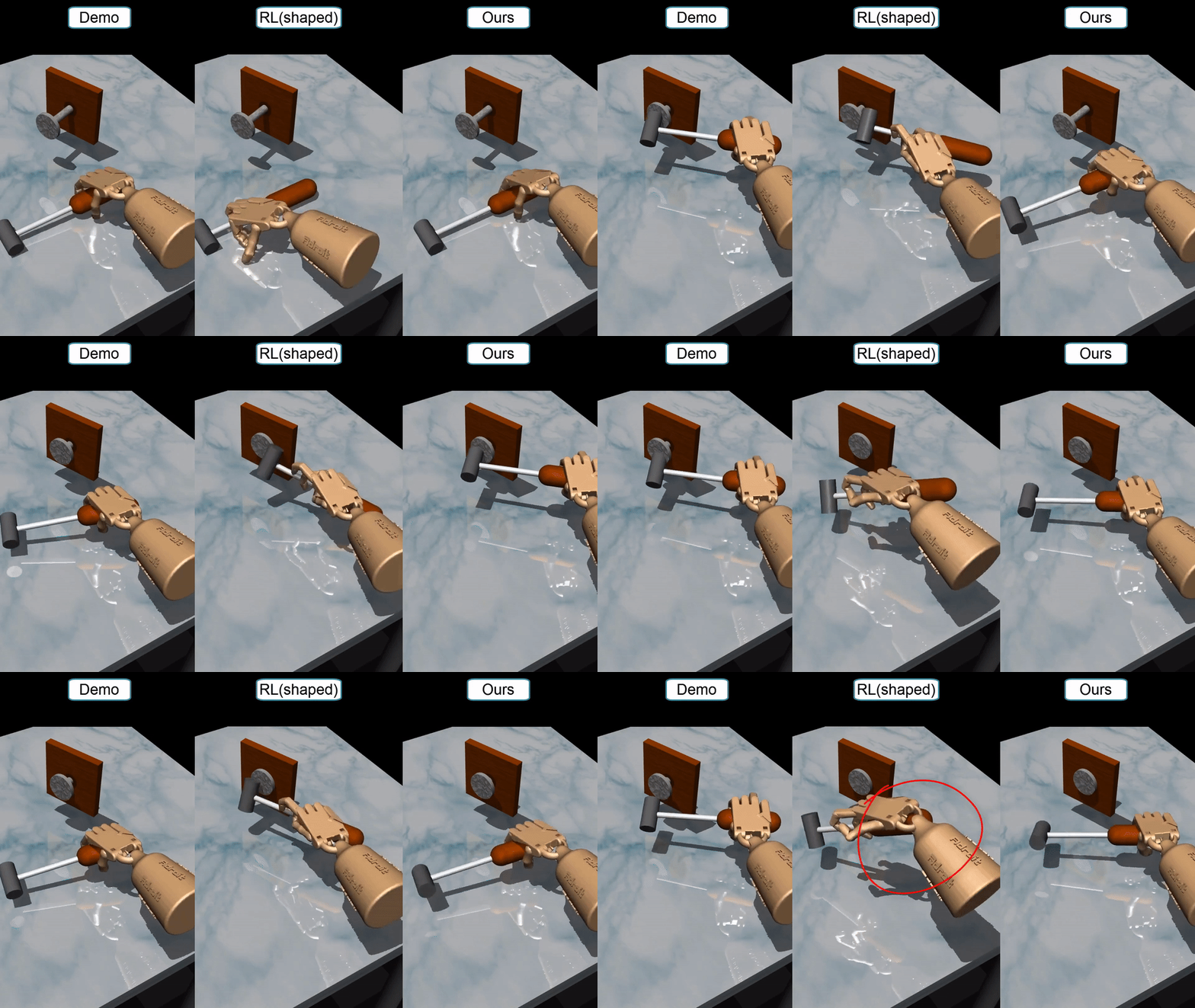
Why does simulation work for walking but not hammering? A key difference, as Bracket Bot CEO Brian Machado explained to Kai, is that “the floor doesn’t do anything.” Because the floor is a static object that doesn’t change in response to a robot’s actions, it’s very easy to simulate.
A hammer isn’t as easy to simulate. You need to account for all of the forces and frictions between the hammer and the hand. If the simulation is even slightly inaccurate, the model might learn a hammering technique that works in simulation but fails in the real world.
Most economically valuable robotics tasks are more like hammering than walking. They require robots to manipulate objects that behave in complex, hard-to-simulate ways. Think, for example, about a rope, a half-full glass of wine, or a balloon. We don’t know how to simulate objects like these with enough fidelity to train a robotics model. And we really don’t know how to simulate the far more complex behavior of people and animals.
This has big implications for the future of robotics. If a task can be simulated, then a company can collect “years worth of simulated demonstrations in a few hours,” as Figure did when it was training its robots to walk. Robot performance can be improved rapidly at low cost.
But if simulation isn’t an option, then companies are left with much less appealing choices. They can hire humans to generate training data — either by teleoperating a robot or performing tasks themselves — and then use that data to train a robot. Or they can deploy a robot that doesn’t yet work very well and have it improve by trial and error.
Each of these approaches has its advantages and downsides. But all of them are much slower and more expensive than training in simulation. And this is a major reason I — and many robotics experts — are skeptical that general-purpose robots will be ready for widespread commercial deployment in the next few years.
AI companies face similar difficulties outside of robotics. You might think that white-collar work doesn’t suffer from a sim-to-real gap because it mostly happens on computers. But I think that’s wrong. Almost every white-collar profession involves interacting with other people and the larger world — which is almost impossible to simulate. And this fact limits how quickly AI models can replace human workers in these professions.
Math and coding are easy to simulate
In 2016, a DeepMind model called AlphaGo defeated Lee Sedol, one of the world’s best human Go players. Soon afterwards, DeepMind developed AlphaZero, a more powerful successor that achieved superhuman performance at Go (as well as chess and shogi) by playing millions of games against itself.
You can think of Go and chess as tasks with very small sim-to-real gaps. AlphaZero’s self-play is reminiscent of Figure’s virtual robots teaching themselves to walk in simulation. And as with Figure’s virtual robots, the skills AlphaZero learned in training transferred well to “real-world” games against human beings.1
Something similar has been happening in programming. Over the last 18 months, coding agents have revolutionized the programming profession. Instead of writing code themselves, programmers increasingly describe the code they want and rely on coding agents to generate it.
Here too, rapid progress has been made possible by a very small sim-to-real gap. Like Go, programming languages like Python and JavaScript have precise rules defining exactly how any given program should operate. This means that if LLMs hone their programming skills in a training environment, the skills they learn will transfer well to “real” programming tasks.
So too in mathematics. Four years ago, LLMs struggled with basic arithmetic. This year, frontier models have solved some of the discipline’s hardest problems.
Once again, this has been enabled by a minimal sim-to-real gap. A key move has been to use Lean, a language that allows mathematical proofs to be stated precisely and then verified automatically. This effectively turns mathematical reasoning into a computer programming task; frontier labs can automatically check whether a model has produced a valid proof for a particular problem. A proof that can be written in Lean is likely to be accepted by human mathematicians as well.
In short, we know how to train an AI model to achieve superhuman performance on a task if we can replicate that task in a training environment. In robotics, that describes locomotion tasks like running, jumping, and dancing — but not manipulation tasks like folding a T-shirt or painting a wall. Outside of robotics, games like chess and Go are easy to simulate. So are intellectual tasks like programming and proving mathematical theorems.
A crucial question for the AI industry is whether similar training techniques will work for other white-collar professions. Last year, OpenAI announced GDPval, a benchmark designed to measure the performance of frontier models in domains like mechanical engineering, social work, and real estate. In this benchmark, a model is given a PDF, spreadsheet, or other document describing a task and is asked to produce a new document in response. For example, given a spreadsheet of recent purchase orders at a company, a model might be asked to generate a new spreadsheet listing likely data entry errors.
Frontier labs hope they can train AI models to perform these kinds of cognitive tasks as effectively as they write computer code. And models have made significant progress on GDPval. When the benchmark was released a year ago, the best model, Claude Opus 4.1, got 47.6%. Today’s best models are scoring more than 85%.2
So are we about to see AI agents overrun finance and law and social work and architecture and mechanical engineering in 2027 the way they overran software engineering in 2026? I’m skeptical. And the concept of sim-to-real gaps helps to explain why.
来源:Timothy B. Lee:Understanding AI · understandingai.org