美联航 CEO 质疑 Boom Overture 超音速客机 2029 年交付计划,Boom 转向 AI 数据中心燃气轮机业务
Supersonic airliner in doubt as company shifts to powering AI data centers
美联航 CEO Scott Kirby 在 10 月 28 日的播客访谈中表示,Boom Supersonic 的 Overture 超音速客机不会按官方时间表在 2029 年交付, FAA 认证仍有诸多障碍。
Manage your consent preferences
If you are a resident of Colorado, Connecticut, Virginia, Utah, Oregon, Texas, Montana, Delaware, Iowa, Nebraska, New Hampshire, and New Jersey, Tennessee, Minnesota, Maryland, Indiana, Kentucky, or Rhode Island you have the right to opt-out of Targeted Advertising, including our “sale” and/or “sharing” of your Personal Information (“Opt-Out”). We and our third-party business partners use Personal Information in accordance with our Privacy Policy to serve advertising believed to be of interest to you (“Targeted Advertising”). If you are a California resident, you also have the right to limit the use and disclosure of your Sensitive Personal information in particular circumstances. Please note that you may need to Opt-Out on each website, mobile app, browser, and device you use, and if you clear your browser cookies, you may need to repeat this process. However, if you have created an account to log in across several of our websites and/or mobile apps, we will make reasonable efforts to apply your Opt-Out request to each of those websites and apps. ◦ To Opt-Out of Targeted Advertising on this site: Move the “Allow Targeted Advertising" toggle below to the left and press “Confirm My Choices”◦ To Opt-Out of other “sales”, including for list rentals, data co-ops, and to limit the use and disclosure of your Sensitive Personal Information: Please email privacy_administration@condenast.com or call 1-877-241-4999.
Essential
- On
These cookies are necessary for the website to function and cannot be switched off in our systems. They are usually only set in response to actions made by you which amount to a request for services, such as setting your privacy preferences, logging in or filling in forms. You can set your browser to block or alert you about these cookies, but some parts of the site will not then work. These cookies do not store any personally identifiable information.
Performance
- On
These cookies allow us to count visits and traffic sources so we can measure and improve the performance of our site. They help us to know which pages are the most and least popular and see how visitors move around the site. All information these cookies collect is aggregated and therefore anonymous. If you do not allow these cookies we will not know when you have visited our site, and will not be able to monitor its performance.
Audience Measurement
- On
We use audience measurement cookies in order to carry out aggregated traffic measurement and generate performance statistics essential for the proper functioning of the site and the provision of its content (for example to measure performance, to detect navigation problems, to optimization technical performance or ergonomics, to estimate server power needed and to analyse content performance). The use of these cookies is strictly limited to measuring the site's audience. These cookies do not allow the tracking of navigation on other websites and the data collected is not combined or shared with third parties. You can refuse the use of this cookie by switching off the slider to the right.
Functional
- On
This website uses functional cookies and services to remember your preferences and choices, such as language preferences, font sizes, region selections, and customized layouts. They enable this website to offer enhanced and personalized functionalities.
Social Media
- Off
These cookies are set by a range of social media services that we have added to the site to enable you to share our content with your friends and networks. They are capable of tracking your browser across other sites and building up a profile of your interests. This may impact the content and messages you see on other websites you visit. If you do not allow these cookies you may not be able to use or see these sharing tools.
Allow Sale/Targeted Advertising?
- On
We may transfer or share your personal information to third parties for the purposes of targeted advertising. You can learn more about what information is used for this purpose in our privacy notice.
Confirm My Choices Reject All Accept All
Skip to contentArs Technica home
Sections
Story text
Size Width * Links
- Subscribers only
Learn more
Pin to story
Theme
- HyperLight
- Day & Night
- Dark
- System
Sign In
Sign in dialog...
Sign in
Rough air
Supersonic airliner in doubt as company shifts to powering AI data centers
Boom’s airliner may be delayed, and its data center power business lost a customer.
Jeremy Hsu – Oct 30, 2026 9:41 PM|0
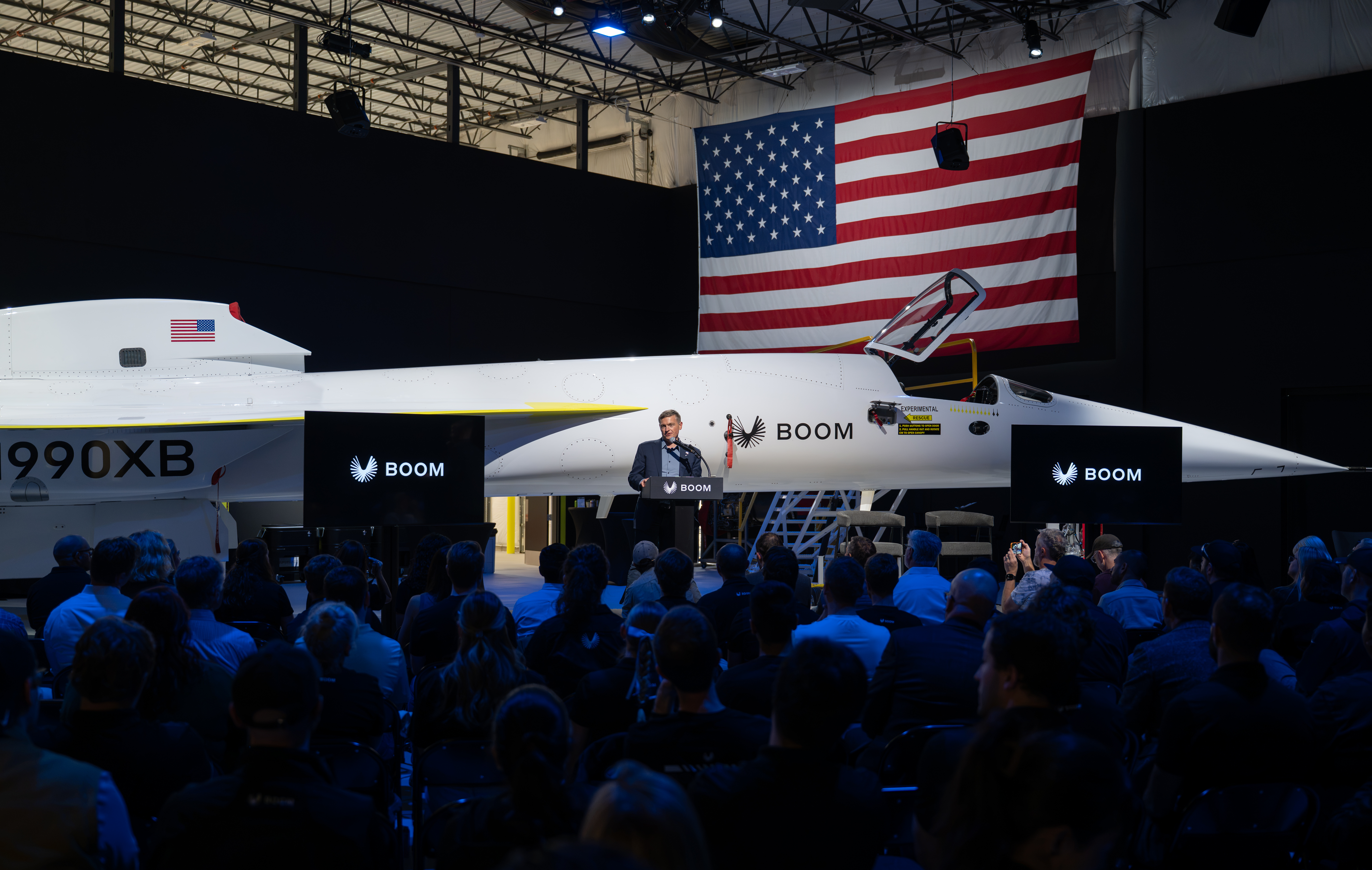
Boom Supersonic CEO Blake Scholl speaks during the unveiling of a factory dedicated to manufacturing natural gas turbines for AI data centers. Credit: Boom Supersonic
Boom Supersonic CEO Blake Scholl speaks during the unveiling of a factory dedicated to manufacturing natural gas turbines for AI data centers. Credit: Boom Supersonic
Text settings
Story text
Size Width * Links
- Subscribers only
Learn more
Minimize to nav
Boom Supersonic CEO Blake Scholl recently declared “it’s time for a renaissance in energy and in supersonic flight” as the supersonic airliner company unveiled a Colorado factory dedicated to making gas turbines for AI data centers. But Boom may be facing turbulence after early backers for both ventures have questioned the company’s delivery timeline or backed out entirely.
One of the company’s first customers, United Airlines CEO Scott Kirby, has expressed doubts about Boom’s original plan to deliver the first Overture supersonic airliner in 2029. Kirby’s latest frank assessment came during an interview with the Office Hours: Business Edition podcast that appeared on October 28, 2026.
“‘29 is their official timeline,” Kirby told podcast host Monica Langley. “It’s not going to happen in ‘29—it’s going to take longer.”
Boom first made headlines for flying its XB-1 demonstrator aircraft in 2024 and 2025 to demonstrate a “boomless cruise” concept that harnesses the Mach cutoff phenomenon. Such a feat involves flying just beyond supersonic speeds at higher altitudes under specific atmospheric conditions, so that the aircraft’s shockwaves refract upward and minimize the impact on the ground.
The company’s plan to revive supersonic air travel has been backed by the Trump administration via efforts to ease regulations. In June 2026, the Federal Aviation Administration (FAA) proposed a new rule overturning a long-standing ban on commercial supersonic flights over the United States, following an executive order from President Donald Trump.
Ars Video
How Lighting Design In The Callisto Protocol Elevates The Horror
Boom’s pressreleases have previously described achieving aircraft certification and carrying the first paying customers by 2029. The company has conditional agreements with American Airlines, Japan Airlines, and United Airlines involving non-refundable deposits of unknown amounts that would allow the airlines to fully purchase the Overture aircraft once it becomes commercially available.
But United CEO Kirby pointed out that Boom still has “a lot of hurdles to overcome” while developing Overture and getting the supersonic airliner certified by the FAA. “So it’s not a guarantee that they’ll overcome,” he cautioned during the podcast interview, even though he praised Scholl and the company in general.
This follows Kirby’s earlier comments back in March that put the chances of Boom’s Overture airliner entering commercial service at “50-50.” Ars has reached out to Boom for comment.
Although Boom completed building the factory intended for production of the Overture airliner in 2024, the facility located at Piedmont Triad International Airport in Greensboro, North Carolina, has mostly sat dormant since that time. That has raised questions for North Carolina state leaders who provided more than $50 million in taxpayer funding to help build the Overture factory.
Since October 2025, NASA has separately been doing test flights involving the experimental X-59 with a long, needle-like nose designed to reduce the sonic booms from supersonic flight. But this is a completely different approach than Boom’s use of the Mach cutoff flights.
Boom Supersonic’s prototype turbine core called Sprint Core is intended to power both gas turbines for AI data centers and the engine for Boom’s supersonic airliner.
Credit: Boom Supersonic
Boom Supersonic’s prototype turbine core called Sprint Core is intended to power both gas turbines for AI data centers and the engine for Boom’s supersonic airliner. Credit: Boom Supersonic
Boom tries to ride the AI boom
Much of Boom’s recent focus has been on developing natural gas turbines to power AI data centers as an additional revenue stream. On October 22, the company unveiled another factory in Centennial, Colorado, dedicated to producing a 42-megawatt natural gas turbine called Superpower for data centers.
The Trump administration’s public support of Boom was once again evident as US Secretary of Energy Chris Wright participated in the event alongside Colorado Governor Jared Polis.
Boom described its new Superpower factory as making turbine parts while still undergoing construction. It aims to deliver the first gas turbines to AI data center customers in mid-2027 while ramping up annual production to 25 turbines in 2028 and 50 turbines by 2029.
Boom’s detour into powering data centers coincides with many tech companies prioritizing natural gas as the primary power source to get their projects up and running. Some data center developers are even using “mobile gas generators strapped to semitrucks” or “aeroderivative turbines originally designed for aircraft and warships,” according to the market intelligence platform Cleanview.
However, Boom CEO Scholl also acknowledged the recent loss of a $1.25 billion deal that would have seen data center developer Crusoe purchase 29 of Boom’s gas turbines, in a poston the social media platform X on September 25. Crusoe has been involved in building Texas data centers for Oracle, Google and Microsoft that draw upon various power sources including natural gas and renewables.
Scholl said Boom “will be delivering about 250MW of Superpowers next year to other sites” but did not specify theAI data center customers that may be using the gas turbines.
Still, Boom has characterized the development of a gas turbine for data centers as being synergistic with its design of the Symphony engine for the Overture airliner. During the October announcement, it also described having completed a prototype turbine core, called Sprint Core, that is intended to eventually power both the Superpower gas turbine and Symphony engine for the airliner.
That turbine core is set to undergo testing at the Colorado Air & Space Port, with Boom planning to fire the turbine for the first time before Thanksgiving. That would be a concrete development milestone, but the company still has much to do in proving it can get both its AI data center and supersonic airliner ventures off the ground.

Jeremy HsuTech Reporter
Jeremy HsuTech Reporter
Jeremy Hsu is a reporter exploring a wide range of topics across deep tech and AI. He has previously written for New Scientist, Scientific American, IEEE Spectrum, Wired, Undark Magazine and MIT Tech Review, among many other publications, about topics such as deepfakes, data centers, drones, battery tech, robotics, and GPS jamming. He also has a Master of Arts in Journalism from NYU, and a bachelor's degree from University of Pennsylvania in History and Sociology of Science, with a minor in English.
Comments
 Loading comments...
Most Read
 1.Reddit is moving to “a logged-in-only experience,” CEO says
- 2.SpaceX no longer needs NASA, and that's a problem for America's space agency
- 3.Microsoft fixes a Windows 11 annoyance as PC revenue declines
- 4.Analysts find looming launch crisis is "more severe" than anticipated
- 5.Review: You Can See Everything blurs the view of Elizabeth Holmes' deceit
Customize
Ars Technica has been separating the signal from the noise for over 25 years. With our unique combination of technical savvy and wide-ranging interest in the technological arts and sciences, Ars is the trusted source in a sea of information. After all, you don’t need to know everything, only what’s important.
More from Ars
Contact
Manage Preferences
© 2026 Condé Nast. All rights reserved. Use of and/or registration on any portion of this site constitutes acceptance of our User Agreement and Privacy Policy and Cookie Statement and Ars Technica Addendum and Your California Privacy Rights. Ars Technica may earn compensation on sales from links on this site. Read our affiliate link policy. The material on this site may not be reproduced, distributed, transmitted, cached or otherwise used, except with the prior written permission of Condé Nast. Ad Choices
Sign in dialog...
Sign in


来源:Ars Technica:AI · arstechnica.com