Fujifilm 将投资约 100 亿日元把磁带产能提升至 5 倍
Fujifilm to boost tape production 5x as AI fuels archiving demand
Fujifilm 宣布投资约 100 亿日元(约 6300 万美元),在 2026 至 2028 财年将磁带产能提升至 2025 财年的 5 倍,主要用于生产最新一代 FUJIFILM LTO Ultrium10 磁带,这是该公司迄今在专用 LTO 磁带设施上的最大投资。
Privacy Center
Currently, only residents from GDPR countries and certain US states can opt out of Tracking Technologies through our Consent Management Platform. Additional options regarding these technologies may be available on your device, browser, or through industry options like AdChoices. Please see our Privacy Policy for more information.
Social Media
- On
These cookies are set by a range of social media services that we have added to the site to enable you to share our content with your friends and networks. They are capable of tracking your browser across other sites and building up a profile of your interests. This may impact the content and messages you see on other websites you visit. If you do not allow these cookies you may not be able to use or see these sharing tools.
Essential
- On
This website uses essential cookies and services to enable core website features and provide a seamless user experience. These cookies and services are used to facilitate features such as navigation, remember user preferences, and ensure the security of the website.
Targeted
- On
These cookies may be set through our site by our advertising partners. They may be used by those companies to build a profile of your interests and show you relevant adverts on other sites. They do not store directly personal information, but are based on uniquely identifying your browser and internet device. If you do not allow these cookies, you will experience less targeted advertising.
Performance
- On
These cookies allow us to count visits and traffic sources so we can measure and improve the performance of our site. They help us to know which pages are the most and least popular and see how visitors move around the site. All information these cookies collect is aggregated and therefore anonymous. If you do not allow these cookies we will not know when you have visited our site, and will not be able to monitor its performance.
Functional
- On
This website uses functional cookies and services to remember your preferences and choices, such as language preferences, font sizes, region selections, and customized layouts. They enable this website to offer enhanced and personalized functionalities.
Audience Measurement
- On
We use audience measurement cookies in order to carry out aggregated traffic measurement and generate performance statistics essential for the proper functioning of the site and the provision of its content (for example to measure performance, to detect navigation problems, to optimization technical performance or ergonomics, to estimate server power needed and to analyse content performance). The use of these cookies is strictly limited to measuring the site's audience. These cookies do not allow the tracking of navigation on other websites and the data collected is not combined or shared with third parties. You can refuse the use of this cookie by switching off the slider to the right.
OK
English Deutsch Español Français Italiano 日本語 繁體中文
en
Skip to contentArs Technica home
Sections
Story text
Size Width * Links
- Subscribers only
Learn more
Pin to story
Theme
- HyperLight
- Day & Night
- Dark
- System
Sign In
Sign in dialog...
Sign in
Tape Revival
Fujifilm to quintuple magnetic tape output amid AI boom
Low costs and offline security mean magnetic tape still has a job.
Nick Indge – Oct 30, 2026 5:38 PM|0

Credit: iStock / Getty Images Plus
Credit: iStock / Getty Images Plus
Text settings
Story text
Size Width * Links
- Subscribers only
Learn more
Minimize to nav
In an announcement released Thursday, Fujifilm said it will invest roughly 10 billion yen (about $63 million) to increase its production capacity fivefold for an unlikely beneficiary of the AI era: magnetic tape.
Fujifilm attributes the surge in archiving demand to the spread of generative AI, which the company remarked is producing “exponential growth” in data needs worldwide. The 5x increase in production capacity will be measured against fiscal year 2025 production levels.
The investment in Fujifilm’s Kanagawa Factory, Odawara site will make it “the largest investment Fujifilm has made to date in dedicated LTO tape facilities.” The project will run from fiscal years 2026 through 2028 to fund manufacturing expansion and additional personnel, primarily to produce the latest-generation “FUJIFILM LTO Ultrium10” tape.
Mainstream consumers may have abandoned tape decades ago, but the enterprise world never did. Cloud giants rely on tape to back up vast troves of data. Fujifilm’s work with magnetic tape as a data storage medium dates back to the 1950s, and in 2000, the company released its first LTO Ultrium storage tape. In 2011, the company was the first to commercially produce tape with barium ferrite magnetic particles, and in 2025 it debuted the LTO Ultrium10, the first storage solution in the medium to use what the company calls “fine hybrid magnetic particles” by combining barium ferrite with strontium ferrite tech. Each generation of tape (currently Gen 10) has seen meaningful increases in both compressed and uncompressed storage limits.
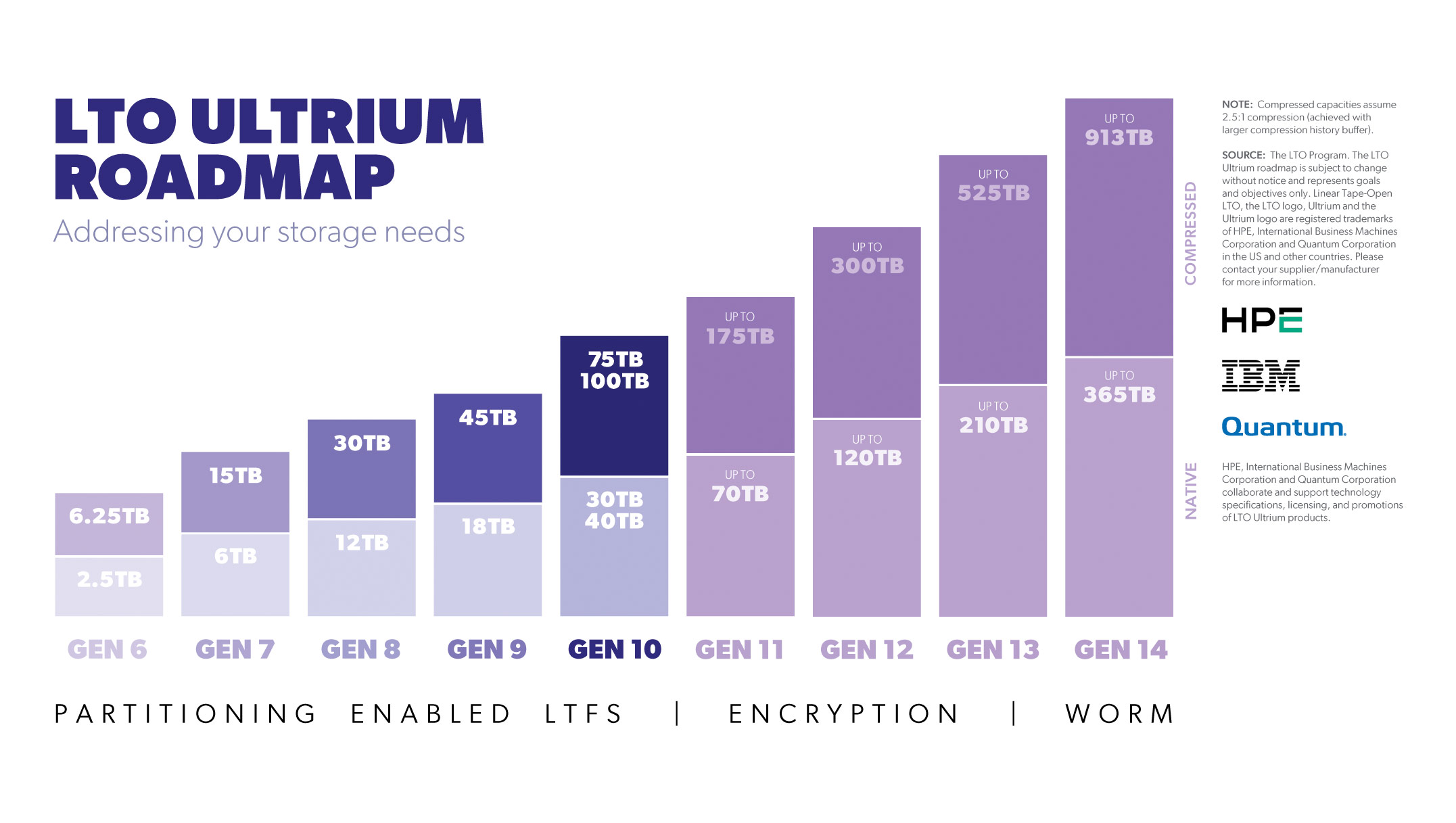
LTO capacity by generation. Gen 10 is the current tech; Gen 11-14 figures are consortium projections for the future.
Credit: LTO.org
LTO capacity by generation. Gen 10 is the current tech; Gen 11-14 figures are consortium projections for the future. Credit: LTO.org
Ars Video
How The Callisto Protocol's Gameplay Was Perfected Months Before Release
According to Fujifilm, “major cloud service and data center operators” have been expanding their use of magnetic tape because it can store large data volumes at relatively low cost. Tape backups can be easily disconnected and stored in a drawer, a vault, or a separate facility. Fujifilm highlights the ability to air-gap tape cartridges as a last defense for user data: “Given the sophistication of cyberattacks, magnetic tape is attracting increasing attention as a means of protecting data from threats such as ransomware.”

Nick IndgeSenior Technology Reporter
Nick IndgeSenior Technology Reporter
Nick Indge is a Senior Technology Reporter at Ars Technica covering hardware, embedded systems, and self-hosted infrastructure. A former security investigator turned tech writer, he writes to help readers escape subscription traps and regain ownership of their digital lives. He lives in Chicagoland with his family and a goofball husky.
Comments
 Loading comments...
Most Read
 1.Reddit is moving to “a logged-in-only experience,” CEO says
- 2.SpaceX no longer needs NASA, and that's a problem for America's space agency
- 3.Microsoft fixes a Windows 11 annoyance as PC revenue declines
- 4.Trump ignored intel on China’s Nvidia spy to protect company’s stock, report says
- 5.Google admits AI search makes less money, but it's fixing that with more ads
Customize
Ars Technica has been separating the signal from the noise for over 25 years. With our unique combination of technical savvy and wide-ranging interest in the technological arts and sciences, Ars is the trusted source in a sea of information. After all, you don’t need to know everything, only what’s important.
More from Ars
Contact
Manage Preferences
© 2026 Condé Nast. All rights reserved. Use of and/or registration on any portion of this site constitutes acceptance of our User Agreement and Privacy Policy and Cookie Statement and Ars Technica Addendum and Your California Privacy Rights. Ars Technica may earn compensation on sales from links on this site. Read our affiliate link policy. The material on this site may not be reproduced, distributed, transmitted, cached or otherwise used, except with the prior written permission of Condé Nast. Ad Choices
Sign in dialog...
Sign in


来源:Ars Technica:AI · arstechnica.com