Anthropic 数学家 Alpöge 与 Claude 合作给出黎曼猜想 Lean 证明
An Anthropic mathematician just solved math’s most famous problem
Anthropic 数学家 Levent Alpöge 与 NYU 教授 Tristan Buckmaster 于 11 月 20 日宣布找到强于 OpenAI 9 月版本的 Navier-Stokes 解;同日 Alpöge 宣布与 Claude 合作发现黎曼猜想证明,以 Lean 语言写成 1700 万行代码,独立数学家用多个 Lean 验证器确认各步骤有效。
On Friday, November 20, Anthropic mathematician Levent Alpöge and NYU professor Tristan Buckmaster announced they had found a solution to the Navier-Stokes problem that was stronger than the one OpenAI released back in September. This would have been huge news if it hadn’t been overshadowed by something even more astonishing. The same day, Alpöge announced that he, working with Claude, had discovered a proof of math’s most famous problem: the Riemann Hypothesis.
Alpöge did not publish a traditional paper written in English. Instead, he released a proof of the Riemann Hypothesis written in Lean, a programming language that allows mathematical arguments to be expressed precisely enough to be verified by a computer.
It was ridiculously long: 17 million lines of code, likely more than all the Lean code ever written by a human. On Saturday, a group of independent mathematicians announced that they had used multiple Lean proof-checkers to verify that all of the steps were valid. The only way Alpöge’s proof could be wrong is if all of these verification programs simultaneously have unnoticed bugs.
Mathematicians are still working through a rival 900-page draft proof written without AI assistance by Alessandro Maria Masullo. Masullo shared his work with other mathematicians months ago, but the writing process hadn’t been completed by the time of Alpöge’s announcement. Stanford mathematician Ravi Vakil announced Masullo’s proof hours after Alpöge’s.
Mathematicians were not surprised by the conclusion of Alpöge’s proof — the hypothesis has been widely assumed to be true for decades. But mathematicians will spend the next few months poring over it to glean insights about how it works.
In a March interview, the UCLA professor Terence Tao told the podcaster Dwarkesh Patel, “Part of the reason we prize problems like the Riemann Hypothesis is that we’re pretty sure a new type of mathematics has to be created, or a new connection between two previously unconnected areas of mathematics has to be discovered to make this work.”
Alpöge’s announcement also generated excitement in the broader AI world because the Riemann Hypothesis has come to have totemic significance. In his influential 2014 book Superintelligence, Nick Bostrom discussed a hypothetical scenario where an AI agent is asked to prove the Riemann Hypothesis. It responds by transforming the solar system into “computronium” to maximize the amount of computing power available to tackle this famously difficult mathematical problem.
In a tweet shortly after Alpöge’s announcement, the legendary AI safety advocate Eliezer Yudkowsky wrote that the Riemann Hypothesis was “the singular math result that had been named, in advance, as the obvious coal mine canary for dangerously advanced AI.” In his view, “this is like a private company announcing they have produced a million tons of 15% enriched uranium.”
So one possibility is that Alpöge’s proof is a sign that AI is terrifyingly close to the kind of superintelligence Yudkowsky and Bostrom have been warning about for a decade.
But that view could also be totally wrong. Maybe the kind of intelligence required to solve the Riemann Hypothesis doesn’t generalize very far beyond abstract domains like math and coding. We could live in a counterintuitive world where AI models can solve the toughest math problems but struggle to plan a wedding or produce a podcast.
This also relates to the ongoing debate over recursive self-improvement. A crucial question is whether today’s AI models are powerful enough to accelerate the pace of AI progress. Solving the Riemann Hypothesis seems similar to the kind of mathematical optimization required to make AI models more capable. So it’s possible that last week’s breakthrough will foreshadow even faster progress in AI capabilities in the coming months. But nobody knows for sure.
The craziest six months in math history
Alpöge’s announcement caps an incredible — possibly terrifying — half-year of mathematical progress. Exactly six months before Alpöge’s release, OpenAI announced that for the first time, an LLM had resolved a somewhat famous problem: the Erdős unit distance conjecture. In September, the company solved one of math’s most prestigious challenges: a Millennium problem called Navier-Stokes (while receiving flak for allegedly bullying Alpöge and Buckmaster, who were working on a rival proof). And just a month later, OpenAI released 706 significant results at once, an event since memorialized in the mathematics community as “The Drop.”
Even with this dizzying progress, many people were surprised that Alpöge’s proof came so soon.
The Riemann Hypothesis, first posed in 1859, was the most famous unsolved problem in all of mathematics. It asked about the behavior of a function over complex numbers called the Riemann zeta function. Knowing where this function evaluates to zero helps mathematicians estimate how frequently prime numbers occur — which is important for problems all across mathematics and physics.1
Hundreds of papers and books have been written that explore the consequences if the Riemann Hypothesis is true. Mathematicians hope that Alpöge’s proof will reveal new ideas that can be applied to other areas of mathematics. But so far, the proof’s extreme length, breadth, and rough state make it impossible to say whether Alpöge’s proof lives up to that promise.
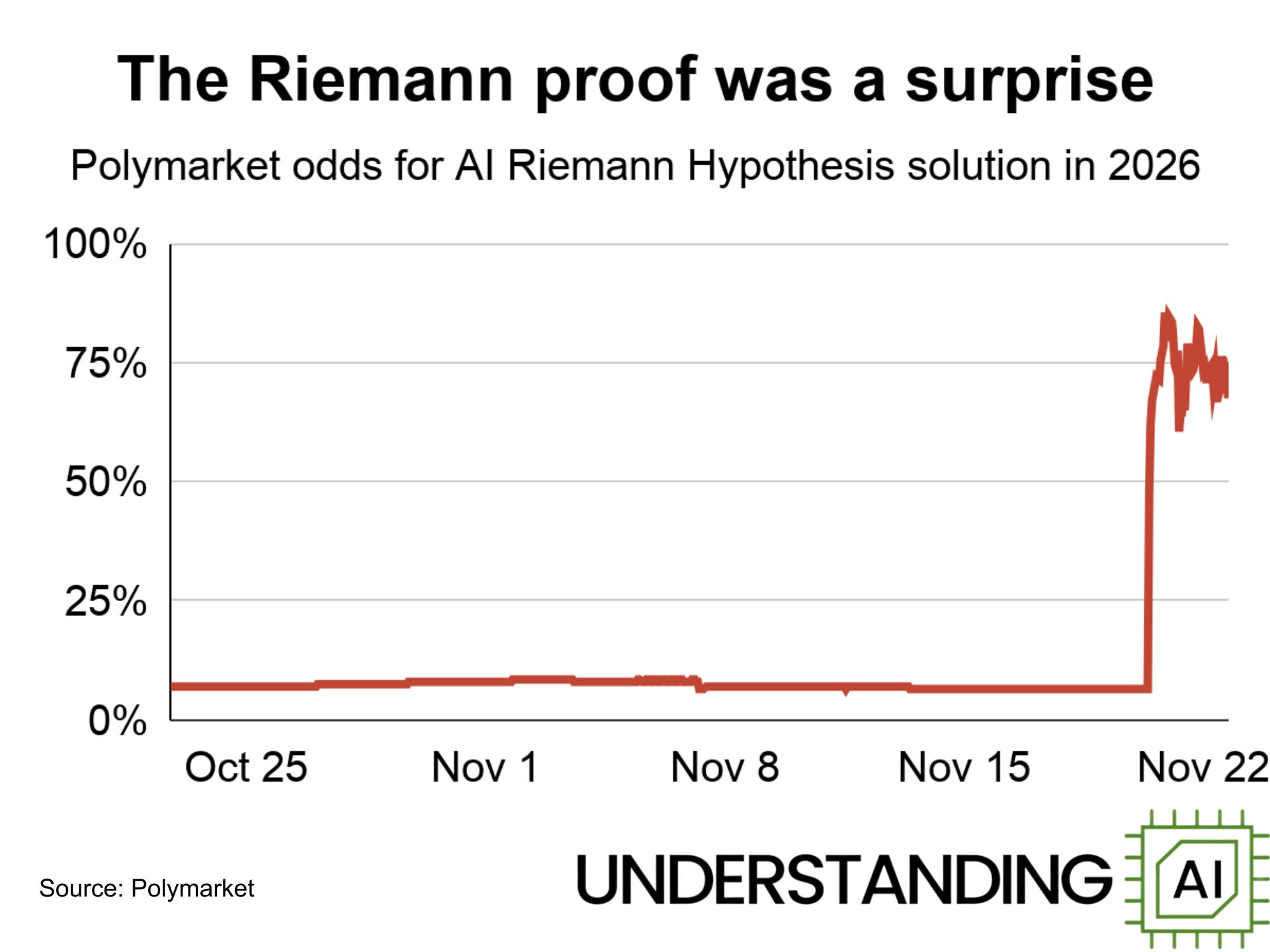
Many mathematicians thought that the Riemann problem might hold out longer from AI progress — Tao recently speculated an AI-assisted proof might come in 2050. Those outside the field seemed to agree. Superforecasters interviewed by the Forecasting Research Institute gave a 10% probability that any additional Millennium problem (of which Riemann is one) would be solved by the end of the year.2 Prediction markets also gave low odds to Riemann falling.
Past computer-assisted proofs have been controversial
This is not the first time that a computer has helped resolve a long-standing math problem. Nor is it the first time that such assistance has proved controversial.
来源:Timothy B. Lee:Understanding AI · understandingai.org