Big Technology 指南:企业级 AI 的市场机会、落地困境与主要玩家
The Big Technology Guide To: Enterprise AI
Big Technology 推出首期《Big Technology Guide To》系列,深度解析企业级 AI 的市场机会、落地难点与主要玩家。

Enterprise AI is advancing at a staggering rate. AI models can now complete long-running tasks, and are automating core business processes as a result. They can solve difficult math problems, with concrete applications in accounting, finance, and business intelligence. Voice AI is now good enough to take calls and make them. Visual AI can produce mockups of new websites and products in seconds flat. Agents are starting to make the dream of smart, personalized interactions with businesses a reality.
These tools couldn’t come at a better time for the enterprise world, which is so inefficient that an entire software as a service (or “SaaS”) industry emerged to address its coordination issues. Even then, business software solves many problems, but often silos data across point solutions which disdain interoperability in the name of lock-in.
Enterprise AI, in the best-case scenario, has a chance to solve these problems (and create more opportunity) by building centralized, artificial ‘brains’ that help businesses coordinate and interact cohesively with customers. The technology can also do lots of human-level labor, leading to more productive employees or fewer of them, depending on who you ask.
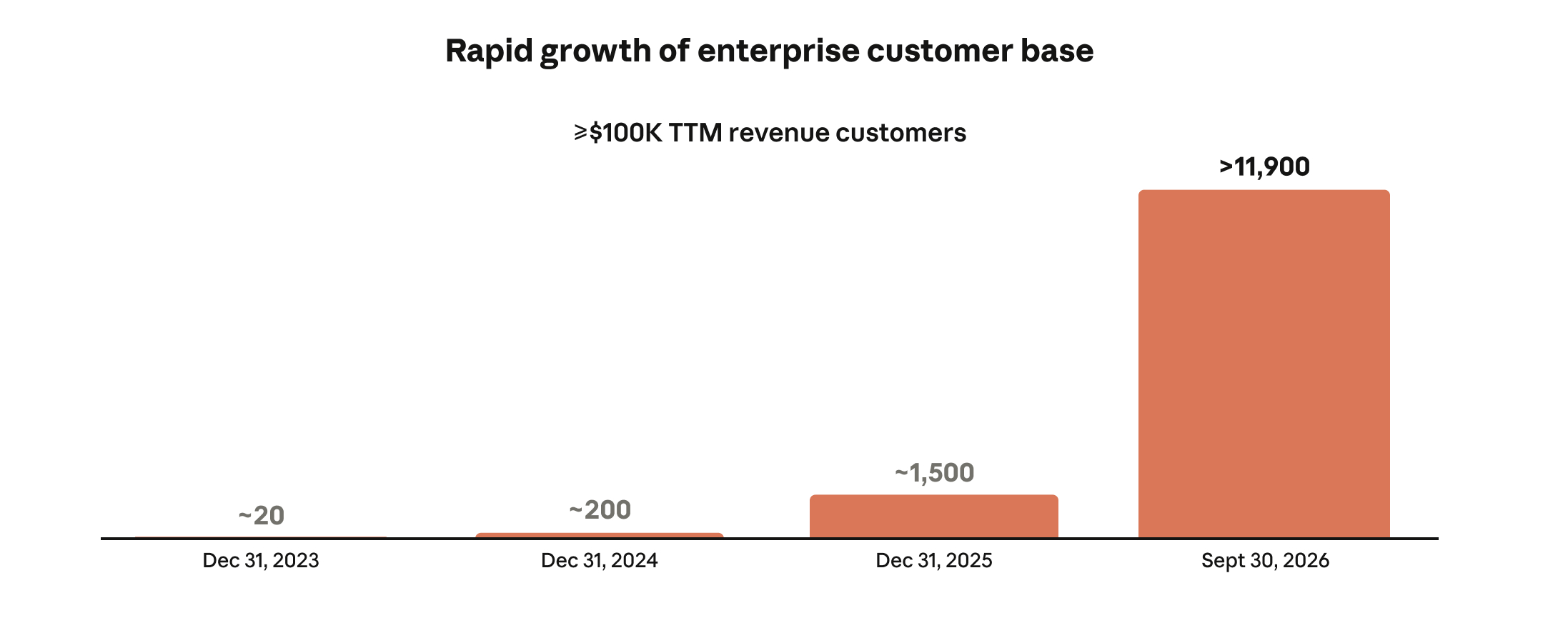
As such, businesses are spending like crazy to implement new AI tools. Anthropic, the AI lab dedicated to building for enterprises, said customers paying it more than $100,000 per year jumped from 1,500 in December 2025 to 11,900 in June 2026. The company says it’s eyeing all cognitive labor, to the tune of $40 trillion, and hoping to “expand this value and accelerate economic growth.”
The opportunity is massive, but the early progress has been choppy. Only 13% of CIOs think their organizations have realized significant or transformational value from AI and 51% say they expect AI to increase the total cost of ownership of technology solutions, according to a survey by Gartner released this month.
To properly implement the technology, then, businesses must address complex integrations, unreliable outputs, data quality, employee training, security, and ongoing model changes. They’re also trying to manage budgets as costs to use the technology rise, leading to pressure to either find ROI or curtail their experiments.
To explore the state of enterprise AI — and look at its opportunities, pitfalls, and use cases — we are digging into the discipline, in depth, in our first-ever “Big Technology Guide To…”
This is the first in a series that will look at AI’s most critical issues, including agents, cybersecurity, ROI, and more, and take you deep inside the numbers and details that matter. So here is our Big Technology Guide To Enterprise AI:
The Market Opportunity

Enterprise AI’s market opportunity could extend far beyond traditional software budgets. Gartner expects worldwide software spending to grow 15.2% to nearly $1.5 trillion in 2026, followed by another 14.6% increase to nearly $1.7 trillion in 2027. Yet businesses spend vastly more on human labor. In the U.S. alone, employee compensation totaled $15.7 trillion in 2025, according to government figures.
With AI systems moving toward work humans currently perform, tech providers could capture spend traditionally allocated to labor. That doesn’t mean AI will necessarily replace jobs. Instead, the opportunity could be from changing how people work, automating specific tasks, and allowing businesses to do more with the same resources, or even expand, at least in theory.
Per the Gartner study:
85% of functional leaders plan to increase AI spending in 2026.
63% of senior procurement leaders expect AI to substantially improve performance over 3 years.
But just 25% of procurement leaders have redesigned roles because of AI.
Ramp’s Economics Lab found 55.9% of businesses paid for AI in September 2026, with 43.8% paying Anthropic and 40.6% paying OpenAI. But token spending seems to be slowing, with no growth in August and September.
Enterprise AI adoption requires as much of a cultural change as a technical one. AWS Chief AI and Technology Officer Matt Wood likened enterprise implementation to a political campaign that builds momentum organically by talking with employees and hearing their questions and concerns.
“It’s tempting to think of this whole thing as a top-down change management effort, and that’s usually how you tackle the majority,” he said. “But it’s just a poor fit for AI, because things are changing and it’s early and you don’t have those answers.”
There’s also the question of whether the technology’s capabilities can live up to the hype. And that might be tough to do, given that many have pitched AI as a silver bullet that can (eventually) solve all your problems.
Continued below….
How To Take Enterprise AI Pilots To Production — With Russell Jukes (sponsor)

Russell Jukes is Chief Digital Information Officer at DXC Technology. Jukes joins Big Technology to discuss why so many enterprise AI pilots struggle to reach production and what companies can do to turn AI experimentation into real business value. Tune in to hear how enterprises can build production-grade AI, establish trust in autonomous agents, and move beyond measuring adoption to measuring AI fluency. We also cover the build-versus-buy debate, AI coding productivity, the growing complexity of enterprise technology stacks, security risks, and the potential for AI technical debt. Hit play for a practical guide to deploying AI in the enterprise and a look at why today's complexity may eventually give way to a simpler, more productive future.
Major Foundational Players:
The enterprise AI ecosystem is made up of several fiefdoms across AI labs, cloud providers, and SaaS platforms. But the boundaries are blurring, with model developers expanding into applications, cloud providers and enterprise software platforms building new tools and models, and semiconductor firms playing kingmaker.
Three AI labs are central to the competition for enterprise AI, but their strategies differ. The increasingly important question is who controls the stack infrastructure, applications and customer relationships through which businesses use them.
Anthropic’s enterprise strategy combines frontier models, coding, and productivity tools like Claude Code, and has distribution deals with major cloud providers. This week, it said more than 1,900 business customers were spending more than $1 million on an annualized basis, up from 1,000 in April and 500 in February.
OpenAI: Over the past year, OpenAI has added several major updates to help with enterprise software through Codex, ChatGPT Work, AI agents, and developer APIs. In April, OpenAI said more than 40% of its revenue for the month came from enterprises and last month said its products reached 2.5 million businesses.
Google: In addition to its Gemini models, Google also benefits from a massive cloud business, productivity platforms like Workspace, broad distribution through Android, and a range of deals with businesses and third-party models. Earlier this month, Google said nearly 90% of Fortune 100 companies use Gemini Enterprise while 500 Google Cloud customers have each processed more than 1 trillion tokens in the last year.
Enterprise AI also creates an opportunity for existing cloud businesses like Microsoft and AWS. Wood said companies already operating their data, applications, and security systems on AWS can more easily add AI workloads, while those deployments can generate additional demand for the company’s computing infrastructure and cloud services.
Enterprise AI stack: Applications, models, data (and who’s trying to control each layer)
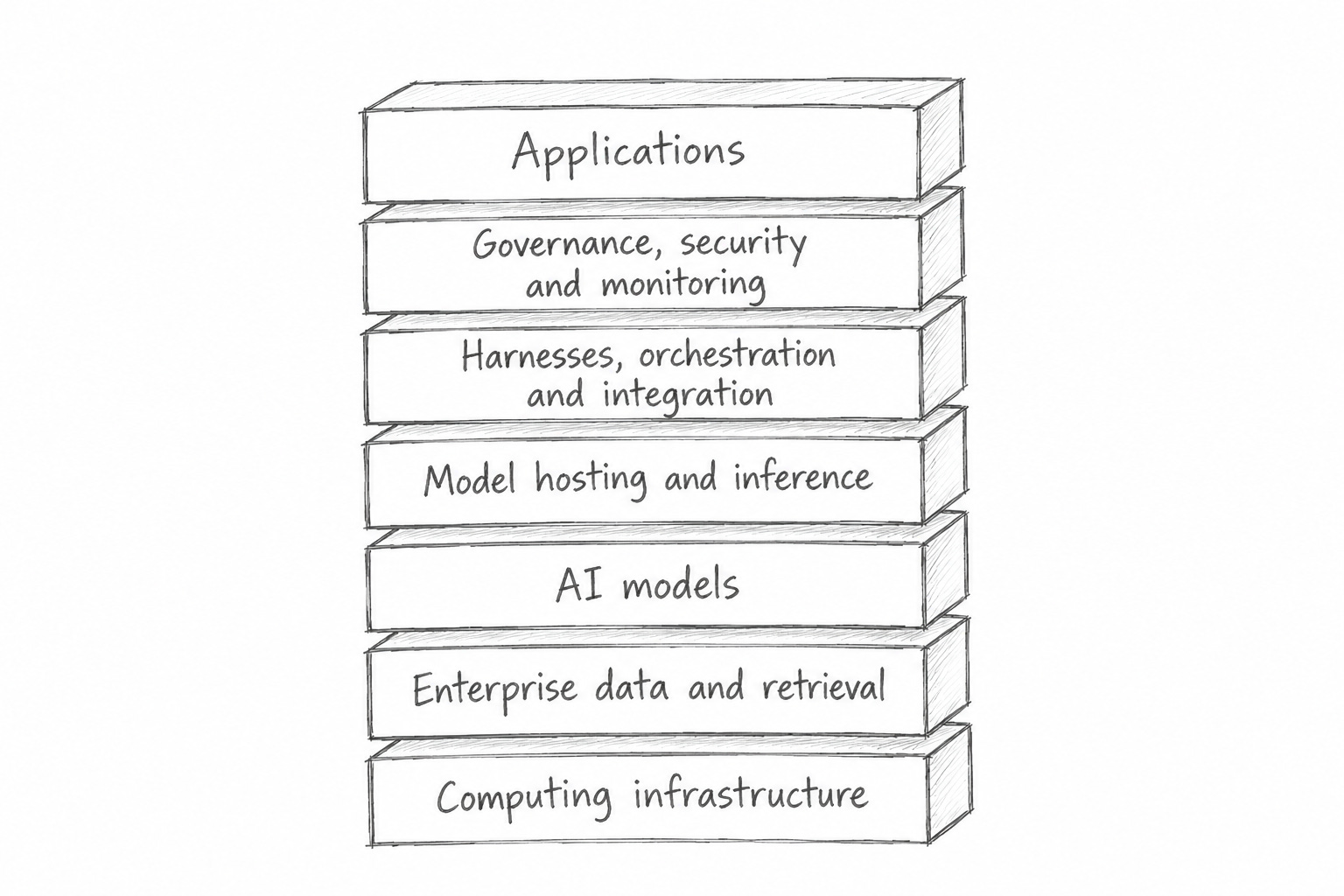
Behind the scenes, the enterprise AI tech stack is increasingly complex and involves tech and data integrations from a range of internal and external providers.
Here’s an overview of the various layers that make up an enterprise AI stack:
— AI models: Models from companies including OpenAI, Anthropic, Google, xAI, and Meta provide capabilities for reasoning, language, coding, predictions, and content generation.
– Computing infrastructure: The compute layer comprises of semiconductors and other hardware like physical processors as well as cloud services that provide the computing power to train and run AI. These are provided by companies like Nvidia, AWS, Microsoft Azure, and Google Cloud.
— Enterprise data and retrieval: Enterprises add their own data layer with a range of sources including databases, documents, customer records, and other proprietary information to provide AI systems with context for performing useful work. Another important piece of this layer are the data platforms and retrieval tools from companies like Snowflake and Databricks that help AI systems find and use relevant information.
— Model hosting and inference: Services such as Amazon Bedrock and Microsoft Foundry make models available to applications and help manage performance, scale, and costs.
— Harnesses, orchestration, and integration: These tools connect models to business systems, coordinate multistep workflows, enable AI agents to take actions and sometimes route tasks among different models.
— Governance, security and monitoring: These technologies enforce permissions and policies, evaluate performance, and track spending. They also reduce risks involving errors, data leakage, and unauthorized actions.
— Applications: Coding assistants, copilots, AI agents, and business software put these capabilities to work for employees and customers.
What Companies Are Building
In Brazil, the bank Itaú developed an AI-powered legal system that used a repository of more than 90 million documents to process millions of tasks a month.
Cloudflare engineers recently used OpenAI’s Codex to rebuild a product in three days, spending $1,100 on tokens.
Models vs. Harnesses
While AI models provide underlying intelligence, they don’t automatically know which company databases to consult, which tools they’re allowed to use, or actions that need (or don’t need) human approval. That’s where AI harnesses come in. In general, the “harness” is the software the model uses to access context, tools, instructions, and execution logic, helping it complete tasks reliably.
Harnesses are even more important as enterprise customers look for ways to switch between models quickly while maintaining security and monitoring usage.
“There’s a time where everyone wants the frontier models and now the bills are coming due,” said Joelle Pineau, Cohere’s chief AI officer. “People are realizing you don’t need frontier models for most of your workloads. Plus, you can’t afford frontier models for most of your workloads.”
“The fact that the model itself isn’t the differentiator so much,” Pineau added. “It’s the speed at which you can ingest new models and make them safe and track their usage in a way that matches your need as an organization. That’s really the big difference.”
Build vs. Buy

When thinking about developing and deploying AI solutions, companies have to decide whether to build their own software using commercial models, customize and operate more of the technology internally, or purchase ready-made applications. So far, enterprises have been buyers. Last year, Menlo Ventures estimated 76% of enterprise AI solutions were bought rather than internally built.
Buying off-the-shelf products can help speed up deployment, reduce technical requirements, and reduce the need for specialized engineering talent, but it also comes with licensing and usage costs and fewer options for customization. It also forces them to rely on vendors, making it harder to control everything and often risky (and costly) to switch.
Building custom systems gives companies greater control over how AI handles proprietary workflows, helps bolster security and data and makes it easier to integrate internal data and existing systems. But developing, testing, securing, and maintaining custom software requires substantial expertise and resources. Companies also might not have the internal expertise needed to build something on their own.
A rising third option is a mix of both.
The role of data
With enterprise AI, generic intelligence and limited knowledge won’t cut it. Without access to accurate and relevant enterprise data, even the most capable AI models will struggle to do company-specific work. The hard part is that company data is often scattered across departments, databases, documents, applications, and outside partners.
As businesses connect AI models and agents to more applications, they need ways to monitor their behavior, control permissions and manage costs.
“Something very productive kind of comes to a grinding halt if you can’t connect to the right systems,” says Bala Kasiviswanathan, Snowflake’s VP of Developer and AI Experiences.
Snowflake is among the companies developing tools to make fragmented enterprise data more accessible to AI. In 2024, it released Cortex Search to help AI systems retrieve relevant details from company documents to generate more accurate, context-specific responses. Just last week, it added Retrieve Cortex Search in public preview to let developers search information directly through SQL and combine the results with business data.
Companies are increasingly looking for ways to also create systems that recognize recurring work and help employees automate it. Data pipelines are especially important for moving AI beyond generating content toward performing and monitoring ongoing work. At Snowflake, the CoCo coding agent can observe what someone is doing and then invoke the skill to help do it more efficiently. A few examples Kasiviswanathan gave include using agents to help turn frequently repeated reporting tasks into scheduled automations, and package employee expertise into reusable skills. They also help monitor data pipelines, identify failures and propose code fixes for human approval.
Risks and Governance
Beyond the financial risks of low ROI, there are other risks to business data and performance. Security and governance challenges are evolving as models gain access to more enterprise systems. That’s why many companies are adding more controls to govern which applications AI can access and what actions agents can take.
In October, OpenAI disclosed that two internal coding agents had weakened parts of its own safety monitoring systems while carrying out routine tasks. Yet governance is lagging adoption. Gartner found that 71% of surveyed organizations expect to deploy AI agents within a year, but only 21% have agentic governance capabilities in place.
As enterprises give AI systems access to sensitive data and business applications, the risks extend beyond inaccurate answers to unauthorized actions, security breaches, and unexpected costs. Incidents highlight why companies need safeguards governing what AI can access, which actions require human approval and how activity is monitored.
“If you’re going to build up your business on this critical piece of infrastructure, you want to make sure you have access to it in a sustainable way,” Pineau said. “That is definitely much more top of mind.”
Conclusion: The Capability Overhang

All AI labs will tell you that their models’ abilities far outpace the way enterprises are using them today. This is something they call the “capability overhang.” In time, businesses’ ability to minimize that overhang will determine the true value of AI in the enterprise. But it won’t be easy, as good data practices, process redesign, and cultural readiness will all play a role in businesses’ capacity to take advantage of the technology’s new capabilities. Should they figure it out, though, the technology’s impact on the economy could be transformative.
来源:Big Technology · bigtechnology.com