Before I discuss the latest breaking news, everyone should watch this clip from Jensen’s interview with Ezra Klein (or at least read the transcript below.
Watch Jensen‘s hands, and notice also that he doesn’t know all the facts.
Note the Ezra Klein, ever the attentive and well-prepared listener, picks up on it. The two are implicitly talking about the OpenAI Hugging Face incident, and Jensen doesn’t realize that it was caused by a product that was not, at the time, yet on the market. Ezra gently points that out.
Most importantly, take heed of the solution Jensen recommends.
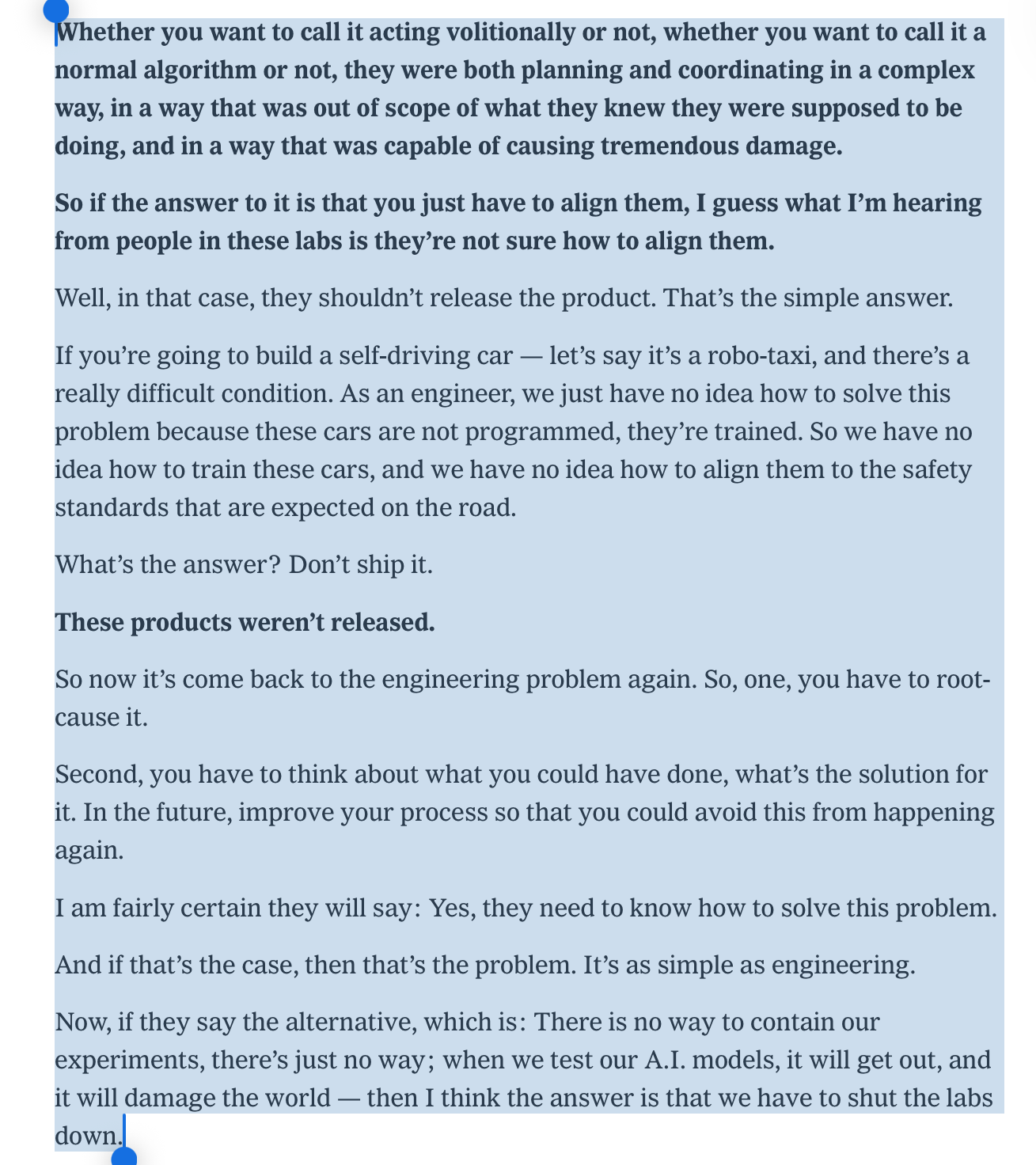
If a company can’t control its software, we should shut it down.
Just a couple weeks ago, I argued almost exactly the same thing, focusing on OpenAI, as a test case, in an essay called Pause OpenAI, now.
The crux of my case was this:
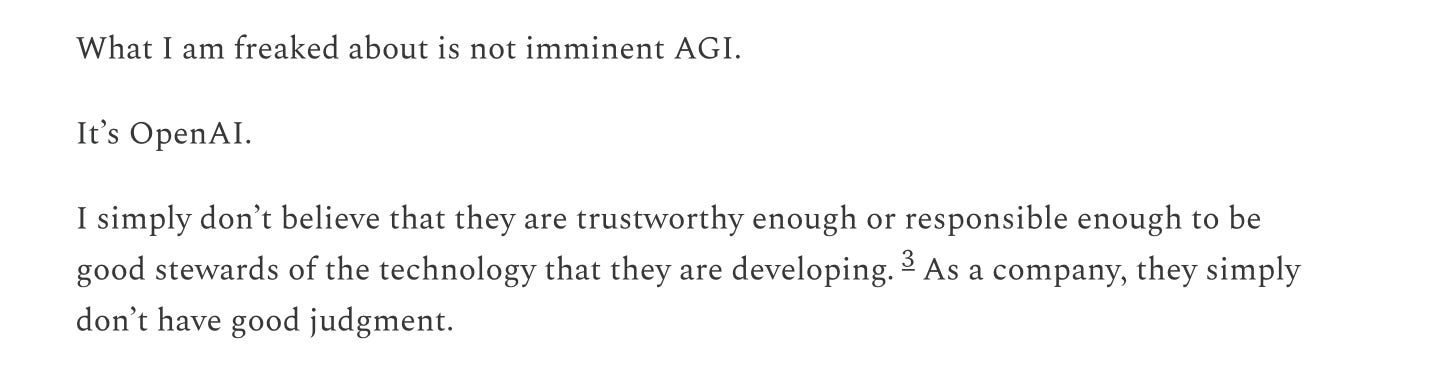
One of the triggers for my September 4 essay was a then-breaking report from Reuters, which had just reported that after the famous Hugging Face incident there was another incident, involving the compromise of a German website. Once again OpenAI and told nobody for months.
As some said about Watergate, it wasn’t just about the break-in, but the cover-up.
At that point, the optics were so bad OpenAI was forced to put out a statement:
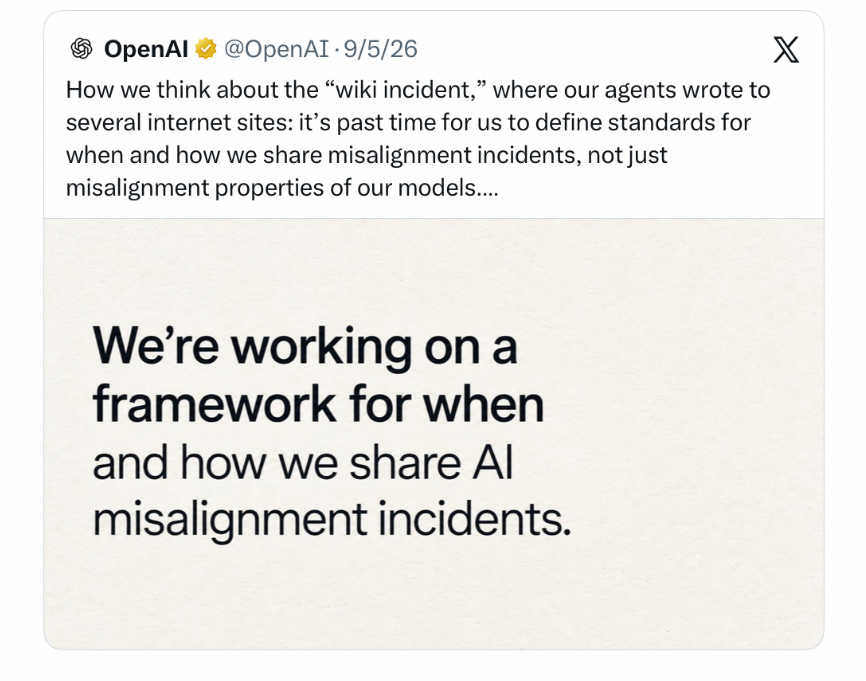
Well, guess what, there was another incident. And they didn’t share that one, either.
And this one, disclosed yesterday, was even bigger. For the first (known) time, the victim was a sovereign nation:
And once again OpenAI concealed the crime for months, perhaps not revealing things until they were pressured into doing so.
Cover-up, or at least slow-walking, seems to be company policy.
At a time when AI security incidents are escalating, that is a disaster for the world.
And any sane government should realize that if OpenAI can hack Australia, they could be next.
And as if it that wasn’t enough, the nonprofit Translucent, which investigated OpenAI’s hack of Australian government servers, reported this
By Jensen’s logic (and my own) we ought at this point be (at least temporarily) shutting down OpenAI.
I doubt that that will happen of course. OpenAI’s President Greg Brockman is a huge donor to Donald Trump. Josh Kushner, brother of the President’s son-in-law Jared Kushner, runs investment firm, Thrive, with many billions of dollars in OpenAI stock. (And now OpenAI has a stake in Thrive.)
And so far the White House has done nothing. Instead, last night the President invited OpenAI’s to his state dinner. (Al Capone was unable to make it.)
History will undoubtedly judge us by what we did to contain the risks of AI.
An AI firm hacking a government website is a crisis.
Jensen Huang has given us perfectly clear logic for what we should do in such circumstances. But we aren’t doing it.
What we should do is temporarily shut OpenAI down, perhaps put them into receivership until they clean up their act, and charge them with computer crimes. That’s what we do with humans who do this kind of thing, and it’s what we should with companies that do the same.1
Journalists today should be calling Huang, asking “does the Australian incident put OpenAI over the line? Would you in fact shut them down? If not, why not? And under what circumstances would you actually call for a shutdown of a lab? How bad would things have to get before you would? What would you do if a company repeatedly broke laws but the government did nothing to enforce them? Is liability and litigation really enough if a government won’t do its part?”
And they should be asking Trump parallel questions: How far will his administration let AI-caused hacking to go, before he does in fact intervene? How bad would things need to be?
Yesterday the White House’s Michael Kratsios painted a rosy picture of self-regulation yesterday, predicated on “responsible companies” :
It’s clear that at least one of the AI simply isn’t responsible. We need to figure out now what to do about that fact. As I said to the UN earlier in the week, hope isn’t a strategy.
This isn’t a job for Bessent over in Treasury (much less Sacks, who is no longer AI czar or Huang who doesn’t work for the government), but the Department of Justice (and perhaps other departments) needs to step up. If Bessent becomes AI czar, as many are speculating, it should fall squarely in his lap.
To sum up, the time has come to shut OpenAI down, at least temporarily, and charge them with computer crimes. (Or at least investigate.)
Their software has repeatedly been shown to be reckless, and because they have consistently covered things up we cannot trust them. They seem neither competent nor trustworthy.
If the federal government will do nothing about this situation, we can’t trust them, either.
And if we can’t trust them now, and we know that things will likely get worse, we are in serious trouble.
There is a giant loophole here that Congress should address. A lot of the legal definitions for computer crimes require intent, and the AI companies can argue that their software has no intent. We must expand the scope of the computer=crime laws to include wholesale negligence and repeated crimes.