On Wednesday, US government officials removed a Chinese AI search tool that was briefly deployed on the Federal Register website, Reuters reported.
The change came after social media users noticed an apparent contradiction: The National Archives was using one of Alibaba’s Qwen AI models, even as top US law enforcement claimed that such models illegally copy US frontier models. Earlier this month, the Federal Bureau of Investigation (FBI) named Alibaba among six leading Chinese firms allegedly conducting “industrial-scale distillation” that the agency says is helping America’s biggest competitor cut costs and development time in the race for global AI leadership.
It’s unclear when exactly the National Archives, which runs the Federal Register website, began offering visitors the option to use a Qwen model to search public comments on proposed regulations. So far, the independent agency tasked with increasing public access to federal government documents has not commented on the removal and did not respond to Ars’ request for comment. The White House and the FBI have also not commented.
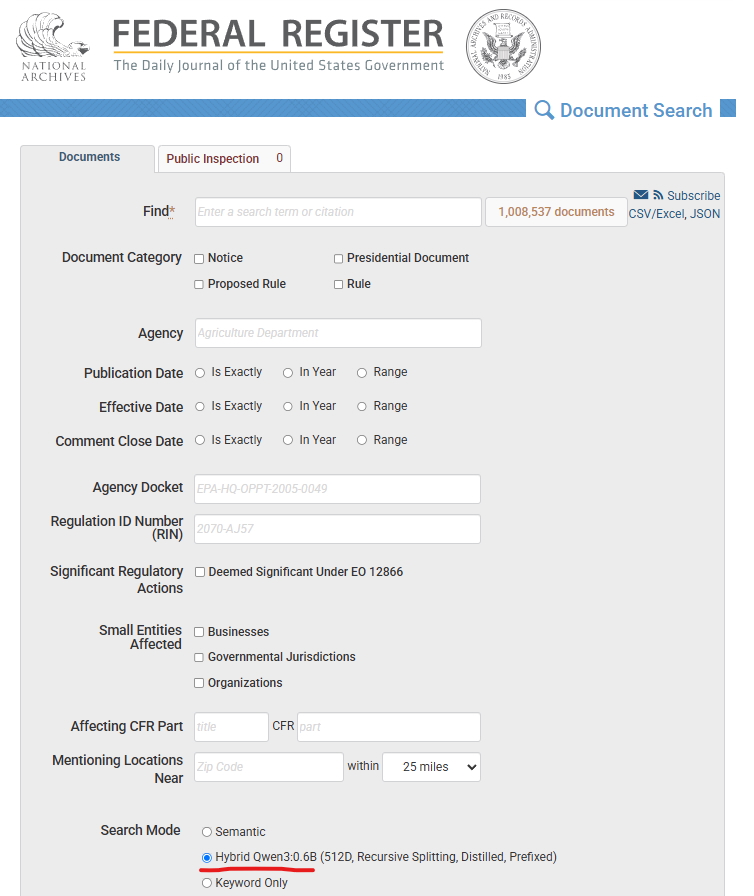
On X, a user with the handle “tleilax___” posted a widely shared screenshot showing the option displayed on the government website on September 15. Reuters’ report noted that an archived version of the site’s source code confirmed that the Qwen model was taken down on Wednesday, so the service was available for at least a day.
Daniel Castro, president of the Information Technology and Innovation Foundation, told Reuters that it is an “insane” disconnect for a US agency to use an Alibaba model while the FBI encourages stakeholders to use only American models.
Ars Video
How The Callisto Protocol's Team Designed Its Terrifying, Immersive Audio
Use probably posed no security risks
Whether the government use of the Qwen model posed a security risk depends on how it was trained, Georgetown University Law Professor Anupam Chander told Reuters. It also matters if any US data was processed by “Alibaba-controlled systems,” Senator Marker Warner (D-Va.) said.
However, although the FBI suggested that using Chinese models could create national security concerns by locking in the US government’s reliance on Chinese technology, experts told Reuters that it’s unlikely the Qwen model’s deployment on the Federal Register site posed any substantial risks.
Chander noted that the site’s content is “already public, so the model was not working with sensitive government information.”
In a report discussing the particular model used in greater depth, the Chinese news site Sina.com explained that the Federal Register used a small open-weight model of “Qwen3 0.6B level,” which is not Alibaba’s largest flagship model. That model is open source, serves solely to retrieve documents, and does not provide complex reasoning or send government data to Alibaba or any third parties.
For US agencies, the Qwen search tool gives the government more control over data because the models can be downloaded and run locally rather than requiring queries to be sent to larger models run externally, security experts told Reuters. The ability to avoid sharing sensitive data is partly why it has become a “default” AI search tool, Sina.com reported, along with its lower, more predictable pricing.
These models could arguably not even be considered Chinese services once a business takes control of them, Sina.com’s report suggested. But the US has only recently started grappling with whether AI models that originate in China but are controlled by American institutions should face the same restrictions as other Chinese services considered higher security risks.
Lawmaker: US should never use Chinese models
Reuters noted that the Federal Register scandal comes “amid a global reckoning about AI safety and a US debate over whether regulatory safeguards on AI are needed or would put the country at a competitive disadvantage.”
Many business owners who increasingly rely on open source models have urged the Trump administration not to restrict access to Chinese models. And China, which has dismissed accusations of frontier model copying, has called on the US to listen to its business community or else risk putting the US at a further economic disadvantage.
Policy research conducted for Congress and submitted to the US-China Economic and Security Review Commission in March suggested that the US may already be at a disadvantage because it focused too heavily on maintaining a lead in frontier AI while failing to advance its own open source ecosystem. In the meantime, China recognized this gap and moved to fill it.
As researchers explained:
US export controls are calibrated to constrain frontier training by restricting access to advanced semiconductors. They do not address the small-model deployment cycle, which requires less advanced compute, draws on openly available base models, and generates advantage through application rather than pre-training. If the models that matter most for industrial AI are small, specialized, and open, the current US policy framework could be targeting the wrong layer of the competition.
Companies like Nvidia and Meta have vowed to help the US catch up. Researchers have warned that if the US loses a broad user base to China, it could set back America’s “ability to set the technical standards and norms that will govern AI development for years to come.” And that loss of global leadership could harm national security and the US economy, some in Congress fear.
US Rep. John Moolenaar (R-Mich.), who chairs the House China Committee, has taken a hard stance, maintaining that “no federal government entity should use a Chinese AI model,” Reuters reported.
“Doing so only makes the federal government more dependent on Chinese AI models, and that is not in the national interest,” Moolenaar said.