We absolutely need to hold AI companies liable for the damage they cause. I wrote about this in my book Taming Silicon Valley, pointing to what many others have long written about it. I am in full agreement with Senator Josh Hawley on this tweet from earlier today, too:
But I am here today to call attention to a growing trend: people on the technolibertarian right calling for liability in AI (which is totally reasonable), but then using that as if it were an argument against regulation.
Take this interview with Joe Lonsdale, amplified last night by David Sacks,
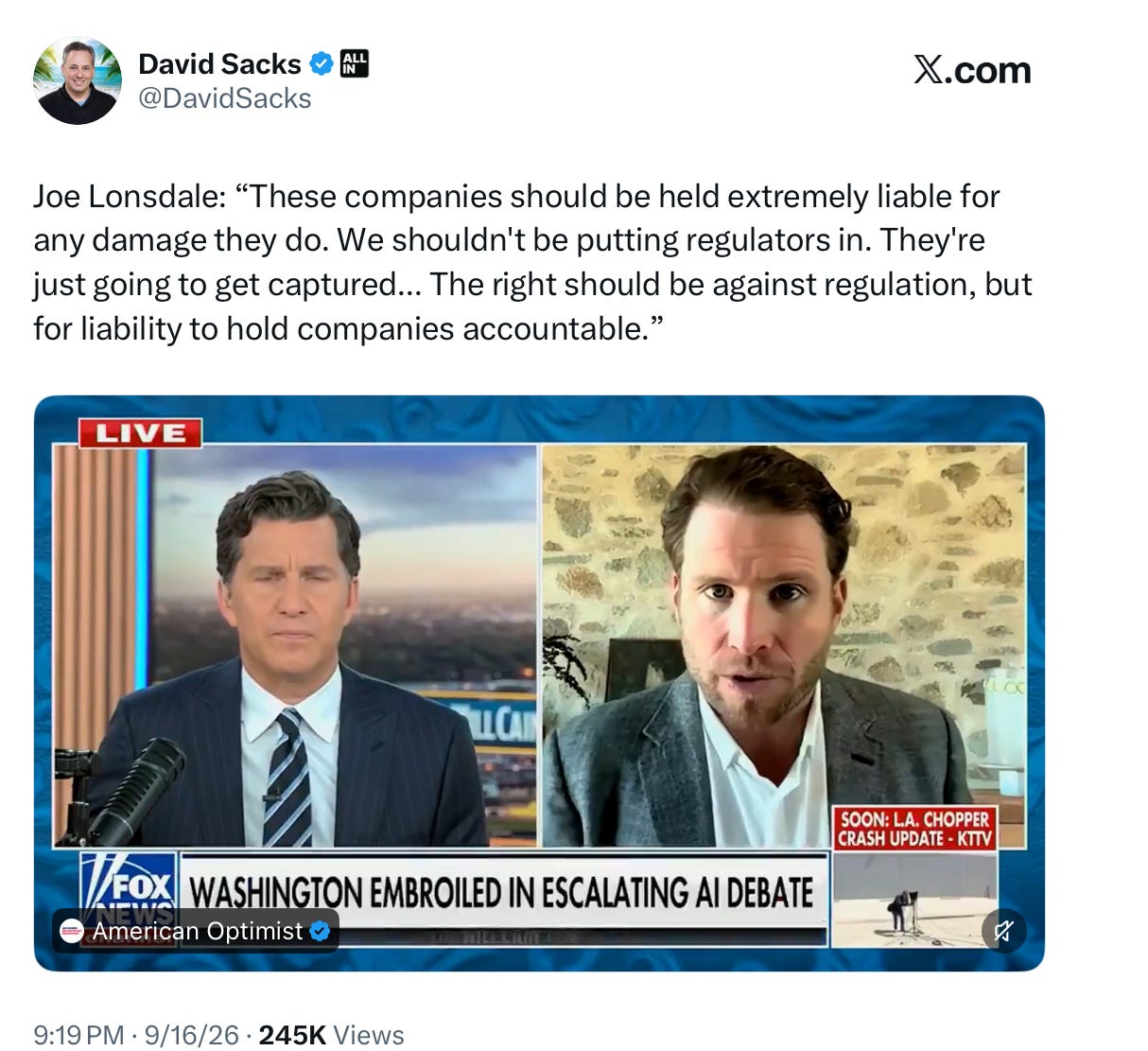
The first part of what Lonsdale says is true (companies should be held liable for the damage they cause, not that the Trump administration has done anything about OpenAI’s string of security incidents), but the attack on regulation simply doesn’t follow.
And indeed, as Mark Cuban pointed out in reply to Sacks, “Presumes we can pass new laws specific to AI. Or, figure out how to apply current laws to AI. Who do you trust to do this the right way?” Without the right regulation, suited for the brave new AI world we now live in now, liability is pointless.
Reading Sacks’s tweet led me to post this:
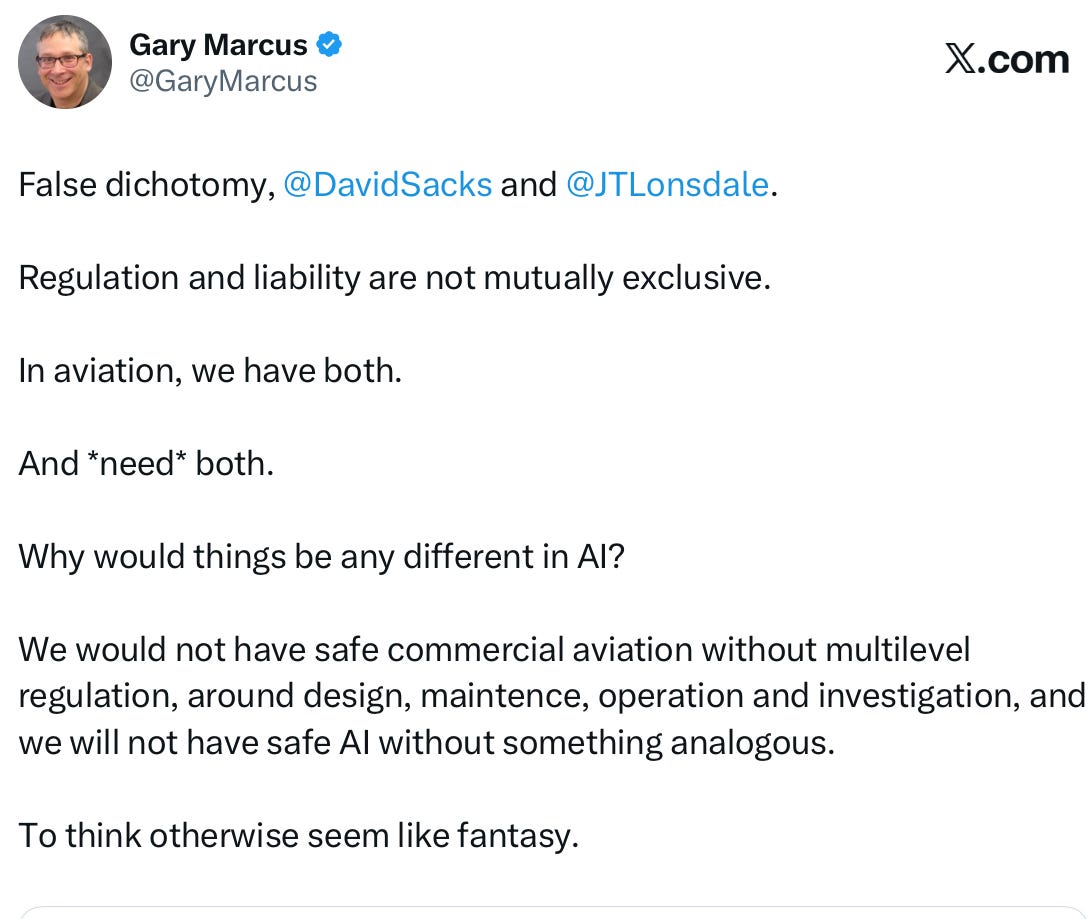
Karen Kornbluh, former Director of the National AI Office and before that former Deputy Principal Deputy CTO to the White House, quickly amplified my own tweet and broadened the point:
I don’t entirely understand why this isn’t obvious.
The argument that liability might be sufficient in itself is hardly new, of course. Senator Josh Hawley (R-MO) once probed me along exactly these lines, back when I testified before the U.S. Senate in May 2023, asking me whether liability (and associated litigation) might be sufficient on its own.
I said no, pushing back, as I am today, arguing for both liability and regulation, including new regulation where existing regulation was either unclear or insufficient. (I noted, for example, that we didn’t quite know how copyright law applied to AI, and that laws might need to be updated.)
It was fun and an interesting exchange, maybe the first time these issues were discussed with respect to AI in the US Senate, and very relevant now, three years later:
Sen. Josh Hawley (R-MO): Okay. The point about practicality leads me to this. I’m interested in this talk about an agency and, you know, maybe that would work. Although having seen how agencies work in this government, they usually get captured by the interests that they’re supposed to regulate. They usually get controlled by the people who they’re supposed to be watching. I mean, that’s just been our history for a hundred years. Maybe this agency would be different. I have a little different idea. Why don’t we just let people sue you? Why don’t we just make you liable in court? We can do that. We know how to do that. We can pass a statute, we can create a federal right of action that will allow private individuals who are harmed by this technology to get into court and to bring evidence into court. And it can be anybody.
I mean, you wanna talk about crowdsourcing? We’ll just open the courthouse doors. We’ll define a broad right of action. Private right of action. Private citizens to be class actions. We’ll just open it up. We’ll allow people to go into court. We’ll allow them presented evidence. They say that they were harmed by, they were given medical misinformation, they were given election misinformation, whatever. Why not do that, Mr. Altman? I mean, please forgive my ignorance. Can’t can’t people sue us? Well, you’re not protection by protected by section two 30. But there’s not currently, I don’t think a federal right of action, private right of action that says that if you are harmed by generative AI technology, we will guarantee you the ability to get into court. Oh, well, I think there’s like a lot of other laws where if, you know, technology harms you there’s standards that we could be sued under, unless I’m really misunderstanding how things work. If the question is are more, are clearer laws about the specifics of this technology and consumer protection’s a good thing? I would say definitely yes.
Gary Marcus: The laws that we have today were designed long before we had artificial intelligence. And I do not think they give us enough coverage. The plan that you propose, I think is a hypothetical, would certainly make a lot of lawyers wealthy, but I think it would be too slow to affect a lot of the things that we care about. And there are gaps in the law, for example. We don’t really…
Sen. Josh Hawley (R-MO): Wait, you think it’d be slower than Congress?
Gary Marcus: Yes, I do. In some ways <laugh>
Sen. Josh Hawley (R-MO): Really?
Gary Marcus: You know, litigation can take a decade or more…
Sen. Josh Hawley (R-MO): But the threat of litigation is a powerful tool. I mean, how would IBM like to be sued for a hundred billion dollars?
Gary Marcus: I am in no way asking to take litigation off the table among the tools. But I think for example, if I can continue we, there are areas like copyright where we don’t really have laws. We don’t really have a way of thinking about wholesale misinformation as opposed to individual pieces of it where say a foreign actor might make billions of pieces of misinformation or a local actor. We have some laws around market manipulation we could apply, but we get in a lot of situations where we don’t really know which laws apply, there would be loopholes. The system is really not thought through. In fact, we don’t even know that [Section] 230 does or does not apply here. As far as I know. I think that that’s something a lot of people speculated about this afternoon. But it’s not solid.
Whatever Hawley may have thought then—maybe he was just asking questions to probe the arguments—he certainly has by now become a firm champion of both liability and regulation His bipartisan AI framework (which I mentioned yesterday) combined with today’s tweet makes that amply clear.
Investors like Sacks may want to protect their investments in AI companies by shielding them from regulation, but the rest of us shouldn’t be fooled.
Postscript: