工作如何沿着指数曲线发生变化
Ethan Mollick
2026 年 6 月 30 日
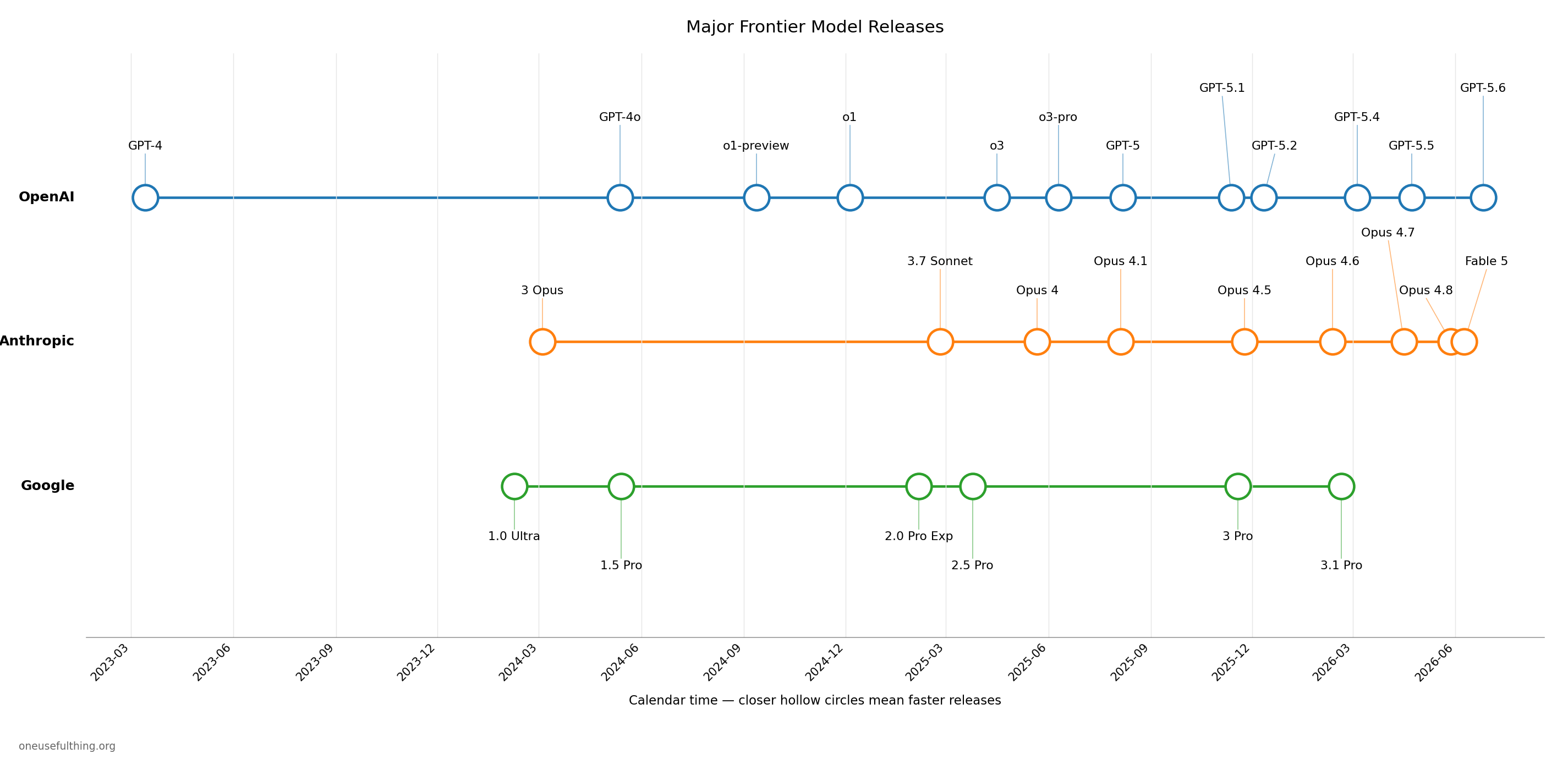
如果你觉得 AI 领域的一切正在加速,你大概是对的。来自美国领先 AI 实验室的更优秀的 AI 模型,发布速度比以往任何时候都快(尽管政府干预曾暂时阻止了对两个最强大模型的访问,即 Claude Fable 和 GPT-5.6)。
但这不仅仅是发布时机的问题。证据也指向能力提升正在加速(尽管前沿依然参差不齐,AI 在许多地方仍然薄弱)。当我们审视 AI 完成实际工作的能力时,这一点尤其明显。有一些不错的评估试图衡量 AI 能完成多少人类工作。其中最著名的两个,来自 METR和英国官方政府的 AI Security Institute,估算的是 AI 在单次提示词下所能完成的工作量相当于多少人类程序员小时的努力。GDPval 则使用专业评审,将许多领域的人类专家与 AI 的表现进行比较。它们全都在以超过指数的速度增长。

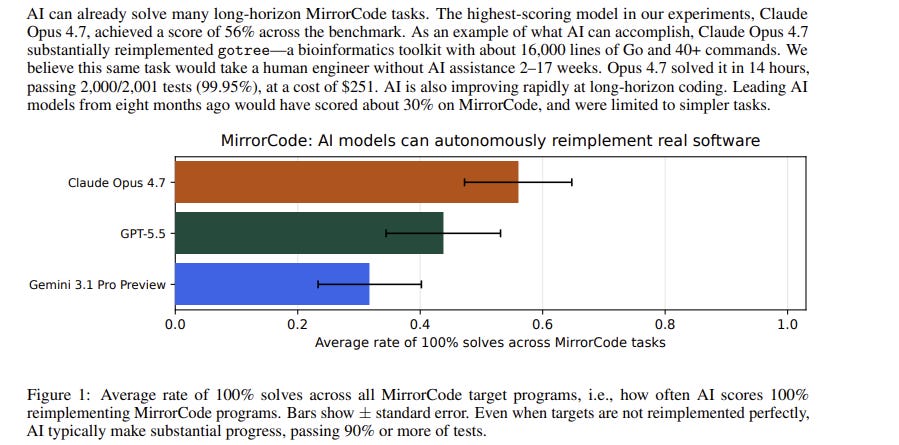
另一家在做类似实验的机构 Epoch 最近发现,Opus 4.7 自主工作 14 小时,能够构建出一个需要 2-17 周人类工程工作量的软件包(消耗了价值 251 美元的 token)。再次强调,AI 系统无法通过每一项测试,运行成本也不总是低廉,但它们的进步速度确实非常快。在我自己的 实验中,我发现 Fable 能够自主工作 9 小时,完成非常复杂的软件项目,而这些项目原本需要一个团队花一周多的时间才能完成。
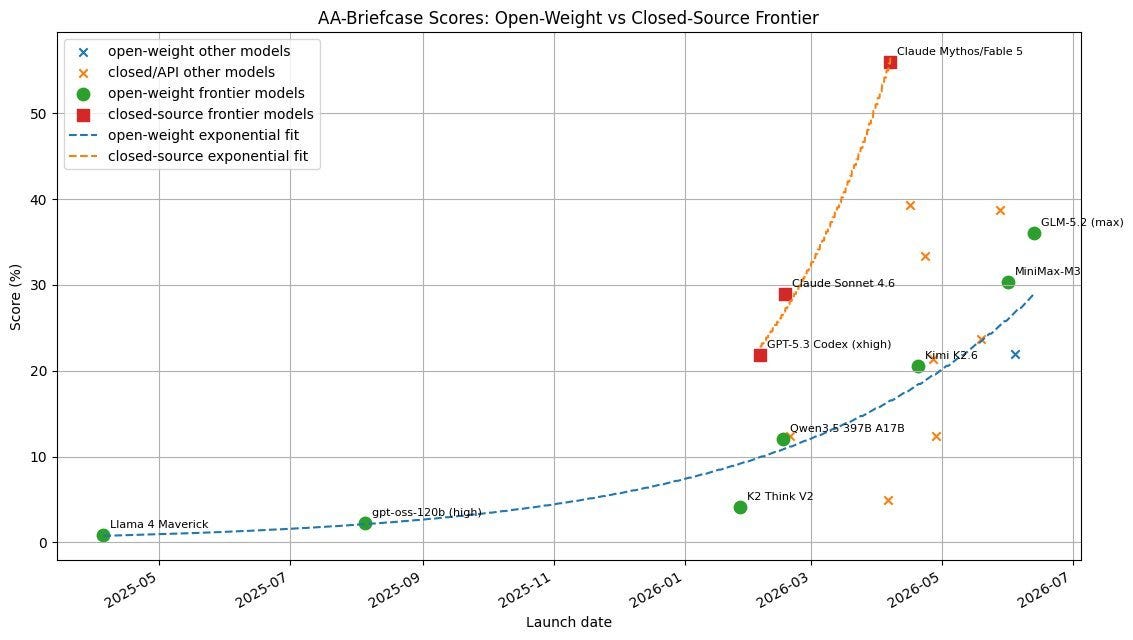
到目前为止,我一直聚焦于前沿模型,即那些“智能”水平最高的模型。它们由三家美国公司制造——Anthropic、OpenAI 和 Google(尽管 Google 已经有一段时间没有发布新模型了)。但还有第二类接近前沿的 AI 模型,通常落后前沿 6-12 个月,它们全部来自中国。这些是开放权重模型,意味着任何人都可以在发布后使用或修改它们(与专有的前沿模型不同)。这使得它们的运行成本相当低廉。它们同样在沿着指数级改进曲线攀升,尽管落后于美国的闭源模型。你可以在我的图表中看到这一点,该图表展示了一项名为 AA-Briefcase 的测试中的 AI 表现,该测试模拟了一个复杂的、为期数周的咨询项目,AI 需要完成多种类型的分析。中国的开放权重模型(其他国家也生产开放权重模型,但没有一个接近前沿)处于它们自己的指数曲线上,落后于美国的闭源模型
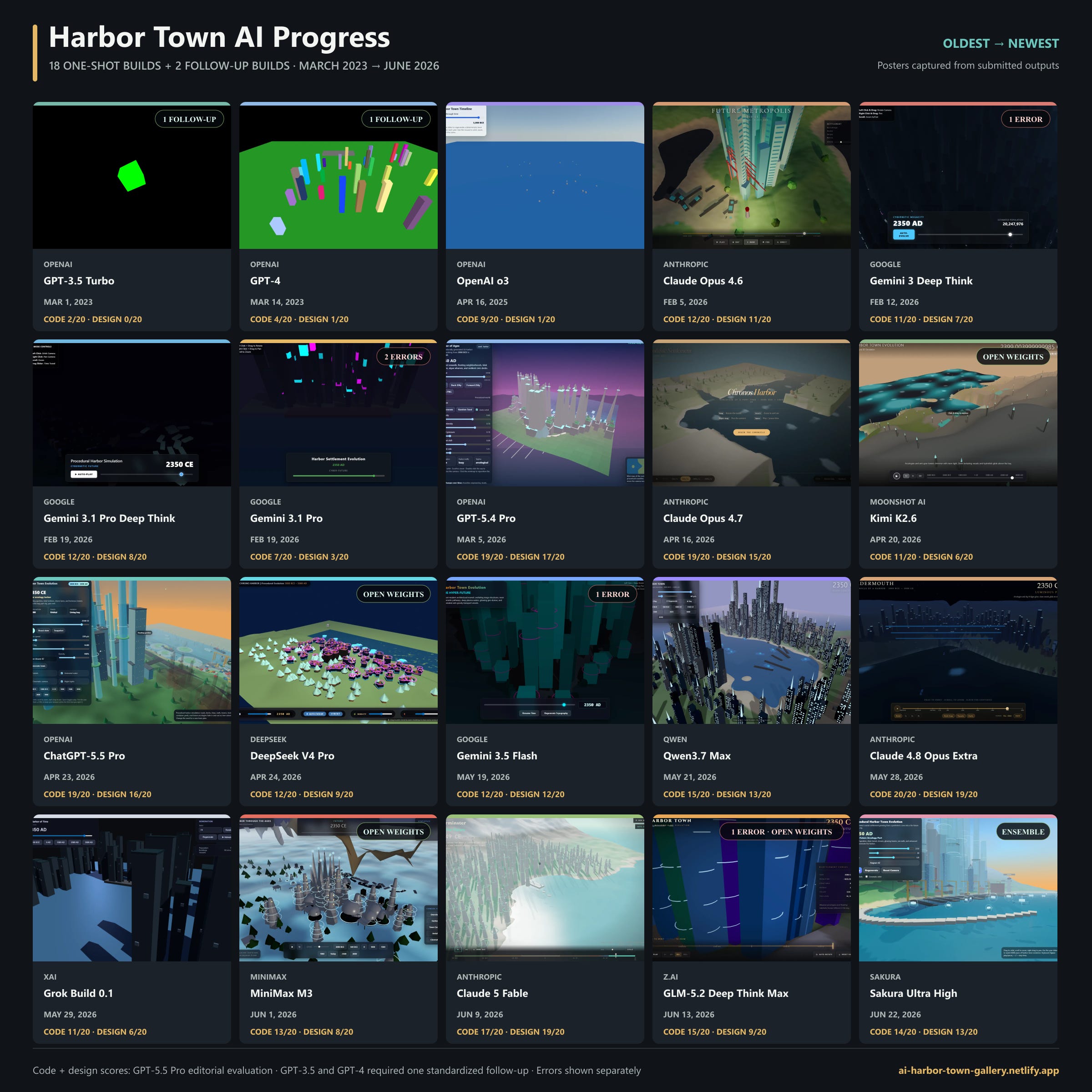
但抽象图表能带给你的洞察终究有限,它们还可能掩盖前沿有多么参差不齐(也掩盖了一个事实:开放权重模型虽然非常惊艳,但表现并不总是与基准测试所显示的相符)。要获得真正的洞察,你需要针对不同用例实际使用 AI,并严格评估它们在你关心的领域表现如何。举一个有趣的例子,我设计了一个测试,让 AI 构建一个随时间演变的港口交互式模拟。你可以在这里体验所有结果。我认为这提供了一个有趣的视角,让我们看到模型之间在设计、风格取向乃至判断力等方面能有多大的差异。随着系统执行越来越长的任务,这些难以用基准衡量的因素会变得更加重要。
我们使用 AI 的方式正在改变
随着 AI 能够执行越来越长的任务,人们使用 AI 的方式正在改变。直到最近,使用 AI 的主流方式还是把它当作一种协同智能。你会让 AI 做某件事,检查结果,然后再让它做你工作的下一步。通过精心的提示词设计和人类的关注,你可以引导 AI 完成复杂且长期的任务。
这种使用 AI 的方式仍然常见且有用,但越来越不是 AI 被用于有价值工作的方式。长时间运行、智能且能自我纠错的 AI 系统不需要持续的人工干预,它们需要一种不同的工作方式(这也是我即将出版的新书 Co-Existence 的主题,你或许想在这里预购)。而且,与聊天机器人不同,智能体还带有额外的机制:为 AI 提供工具访问权限和行动环境的 harness,以及像 Claude Code 或 OpenAI 的 Codex 这样专为智能体构建的应用。因此,一个好的 harness 或应用可以进一步提升 AI 模型本已不断增强的能力。
所以,工作越来越关乎把任务分配给智能体,而不是与聊天机器人协同工作。OpenAI 与学术经济学家的一项联合研究展示了这在它们自己组织内部发生得有多快。关键在于,使用智能体的不只是程序员。法务、人力资源以及其他非技术职能采用智能体的速度几乎相同。对于其他工作场景将会发生什么,OpenAI 或许算得上是煤矿里的金丝雀。
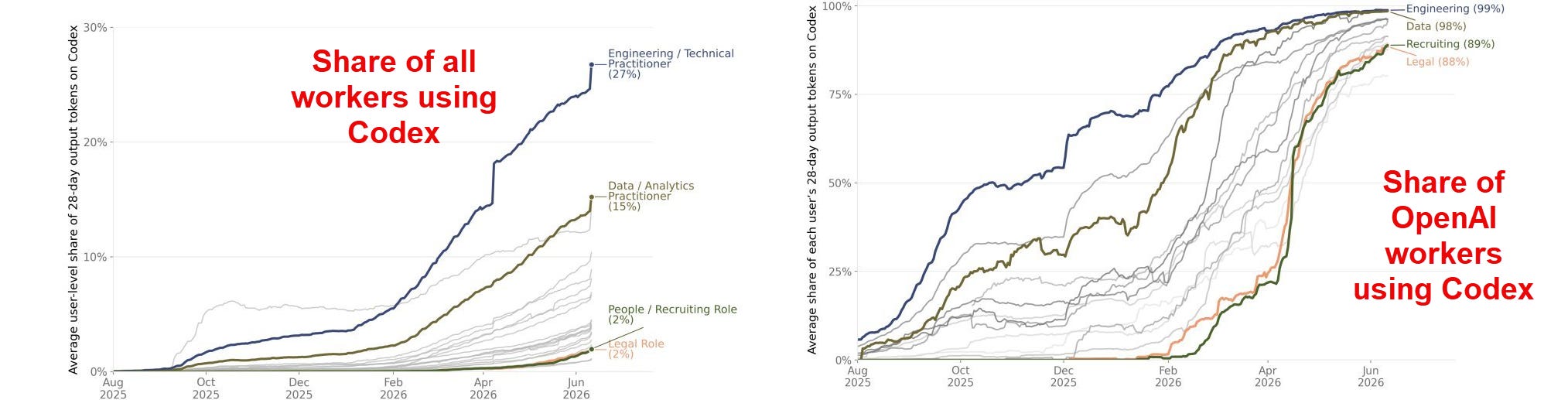
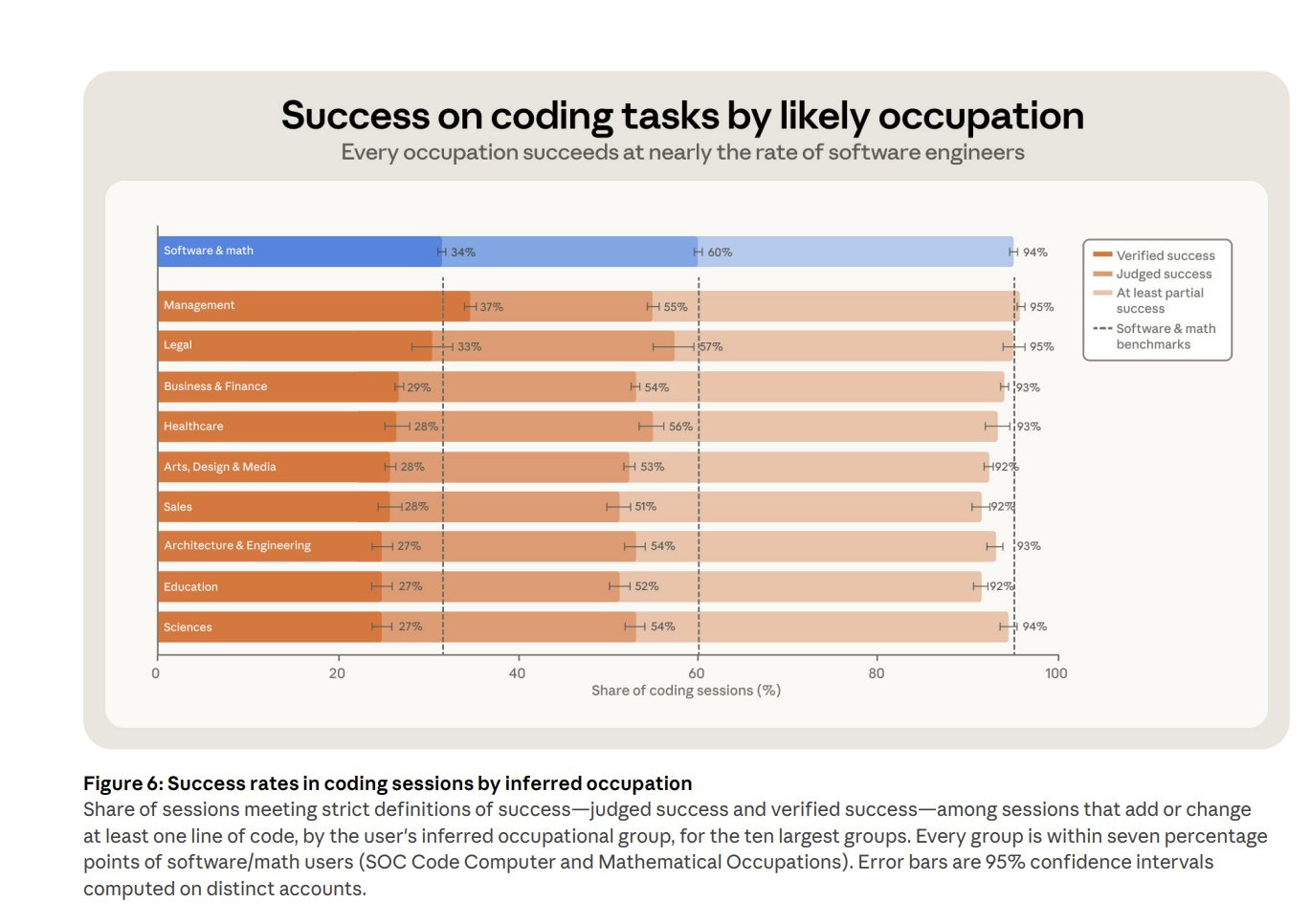
在 OpenAI,工作越来越像是在管理 AI。四分之一的 OpenAI 员工每周至少同时运行四个智能体。而且,随着编码由 AI 在专门的 harness 和应用中完成,其他角色也开始在某种程度上变成程序员。而且他们很擅长这件事。另一项针对 Claude Code 用户的研究发现,软件工程师在实际使用 Claude Code 完成编码任务时,成功率与其他职业相似。
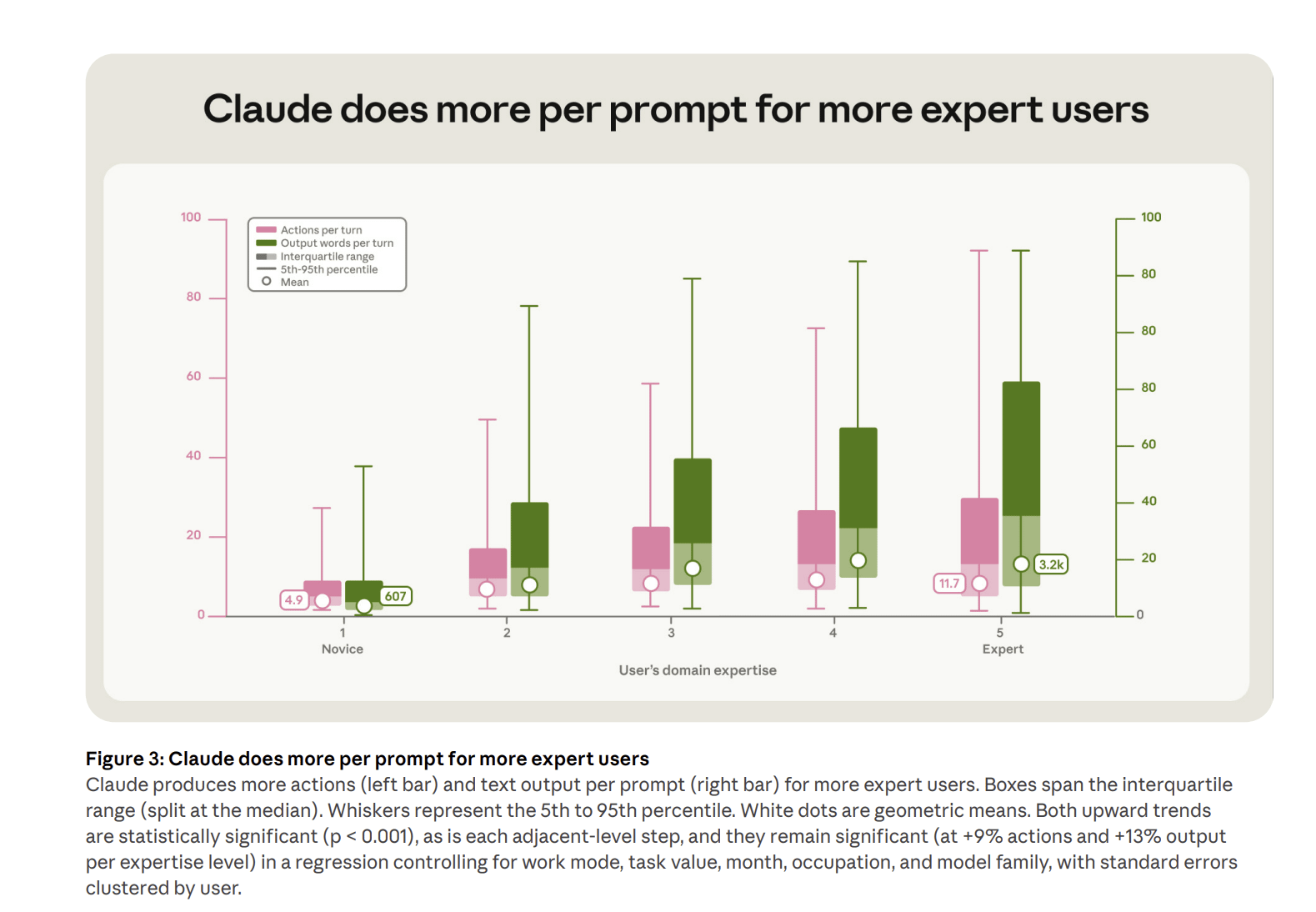
真正重要的并不是用户的职业,而是他们的专业能力。某人在某一领域积累的经验越多,就越能成功地在那个领域使用 Claude Code。而更有意思的是,他们每次提示词从 Claude 那里得到的输出也越有用。
我们正在从一个非专家使用聊天机器人来填补空缺的世界,走向一个专家使用智能体来完成工作的世界。而使用智能体的最佳方式,就是把自己当作一名管理者。
一个时间节点
身处指数增长之中,意味着在每一个固定时间窗口内的变化都比前一个更大。如果你的组织在 2025 年冬季之前的任何时候写过一份 AI 计划,那它描述的是一个只能完成几个小时工作、且错误率相当高的系统。几个月之后,你仅凭一条提示词就能获得十六个小时甚至更多的工作量。这就是为什么 AI 总让人感觉在不断实现飞跃——尽管它只是图表上的一条曲线,我们却不断把能力的稳步翻倍体验为一系列冲击。我们非常不擅长从内部感受指数增长,而我们此刻正身处其中。
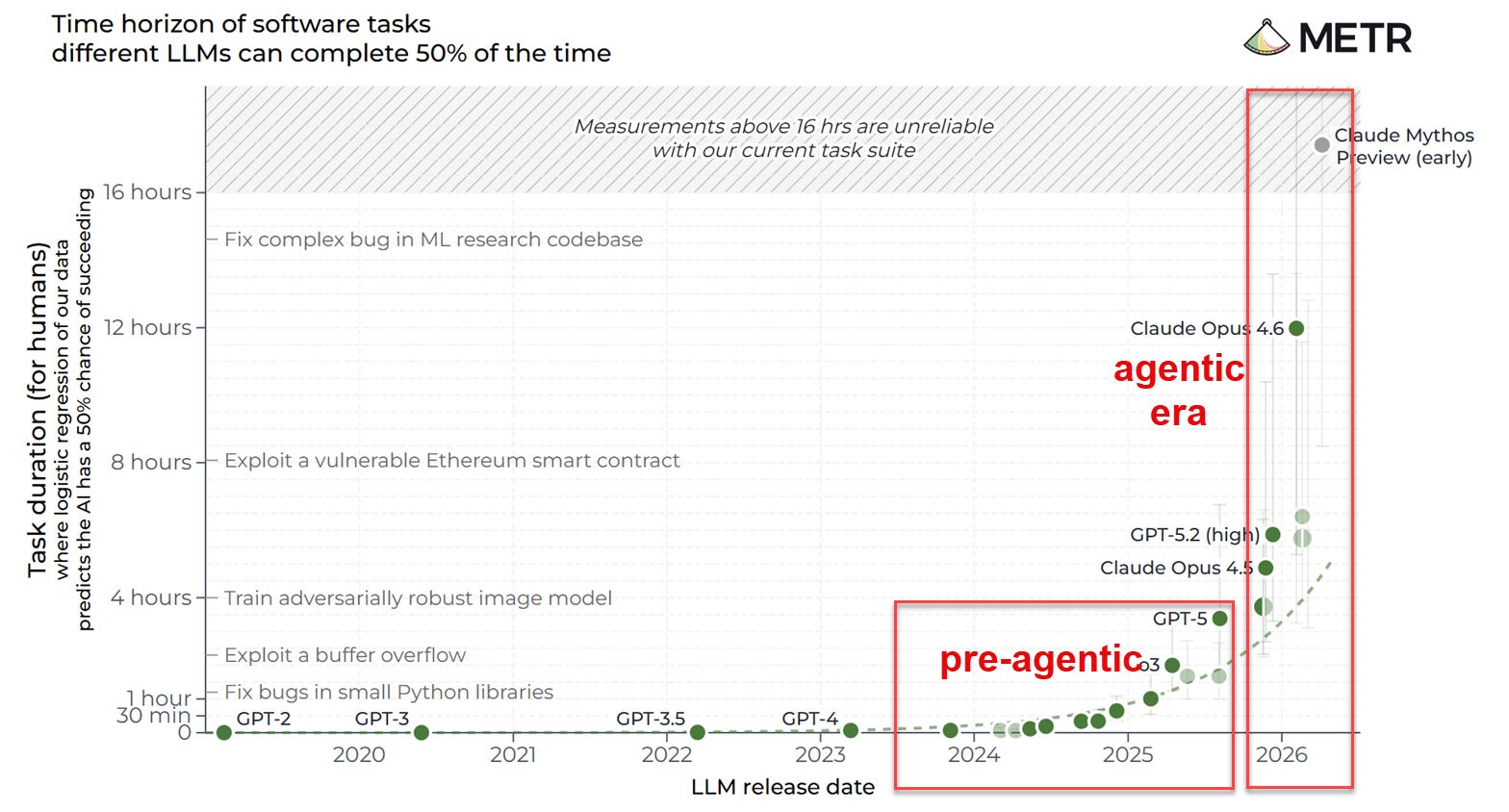
我认为,这也比那些常见的炒作叙事更好地解释了围绕 AI 的动荡。AI 在突然之间就具备成为真正网络安全威胁的能力之前,一直都不具备这种能力,从而在政府最高层引发突然而即兴的政策变化。市场一直低估 AI 是否可能威胁并动摇某种商业模式,直到它突然真的能够做到,导致股市剧烈震荡。
这些颠簸被解读为一个不成熟领域终将趋于稳定的迹象。我不认为它会在短期内稳定下来。这种不稳定,正是当那些以人的速度(或者更糟,以委员会的速度)运转的机构,试图追赶一条本质上绝非人类的能力曲线时会发生的事情。而只要我们处在某种指数曲线上,并且只要这种状态持续,这道鸿沟就只会不断加宽。
How work changes along the exponential
Ethan Mollick
Jun 30, 2026
If you feel like things are accelerating in AI, you are probably right. Better AI models from the leading American AI labs have been releasing more quickly than ever (though government interventions stopped access temporarily to two of the most powerful models, Claude Fable and GPT-5.6).
But it isn't just release timing. The evidence points to accelerating capability gains as well (though the frontier stays jagged, and AIs remain weak in many places). This is especially obvious when we look at the ability of AIs to do real work. There are a few good assessments that try to measure how much human work AIs can do. Two of the most famous, from METR and the UK’s official government AI Security Institute, estimate the amount of human programmer hours’ worth of effort the AI can do with a single prompt. GDPval compares human experts in many fields to AI performance using professional judges. They are all increasing at a better than exponential rate.
Another organization doing similar experiments, Epoch, recently found Opus 4.7, working on its own for 14 hours, was able to build a software package that would take 2-17 weeks of human engineering work (it cost $251 in tokens). Again, AI systems cannot pass every test, nor are they always cheap to run, but they are definitely improving at a very rapid rate. In my own experiments, I found Fable was able to work autonomously for 9 hours to execute on very complex software projects that would have taken a team well over a week to do.
So far, I have focused on the frontier models, those with the highest “intelligence.” They are made by three American companies — Anthropic, OpenAI, and Google (though it has been a while since Google has released a new model). But there is a second set of near-frontier AI models that typically lag 6-12 months behind the frontier, all of which are from China. These are open weights models, which means that anyone can use or modify them after release (as opposed to the frontier models which are proprietary). That makes them quite cheap to operate. They, too, are climbing up an exponential improvement curve, though lagging the American closed models. You can see this in my graph of AI performance in a test called AA-Briefcase, which simulates a complex multi-week consulting engagement where AI has to do many kinds of analysis. The open-weights Chinese models (other countries produce open weights models, but none are near the frontier) are on their own exponential curve, behind closed US models
But abstract graphs only get you so far, and they can hide how jagged the frontier is (and also the fact that the open weights models, while very impressive, do not always perform as well as their benchmarks would indicate). To get real insight, you need to try using AI for different use cases and rigorously assess how good they are in the areas that matter to you. As a fun example, I created a test where AIs have to build an interactive simulation of a harbor evolving over time. You can play with all the result here. I think it gives an interesting perspective on how much models can differ from each other in areas like design, stylistic approach, and even judgement. As systems do ever longer tasks, these hard-to-benchmark factors become more important.
The way we use AI is changing
As AIs can do longer and longer tasks, the way people are using AI is changing. Until recently, the dominant way to use AI was as a co-intelligence. You would ask the AI to do something, check the results, and then ask for it to do the next step of your job. By careful prompting and human attention, you could guide AIs to do complex and long-term tasks.
This approach to using AI is still common and useful, but, increasingly, it is not the way AI is being used for valuable work. Long-running, smart, and self-correcting AI systems do not need constant human intervention, and they require a different way of working (this is also the subject of my upcoming book, Co-Existence, which you might want to pre-order here). And, as opposed to chatbots, agents come with extra machinery: harnesses that give the AI access to tools and an environment to act in, and apps built for agents like Claude Code or OpenAI's Codex. As a result, the already increasing ability of AI models can be improved still further by a good harness or app.
So work is increasingly about assigning work to agents, rather than working together with chatbots. A joint study by OpenAI and academic economists shows how quickly this is happening inside their own organization. Critically, it isn’t just coders who are using agents. Legal, HR, and other non-tech functions have adopted agents at nearly the same rate. OpenAI may be a sort of canary in the coal mine for what will happen elsewhere in work.
Increasingly, work at OpenAI looks like managing AI. A quarter of OpenAI workers have at least four agents running at one time every week. And, as coding is done by AIs in specialized harnesses and apps, other roles start to become coders of a sort. And they are good at it. A separate study of Claude Code users found that software engineers had a similar success rate to other professions when actually using Claude code on coding tasks.
What actually mattered was not the profession of the user, but their expertise. The more domain experience someone had, the more successful they were in using Claude Code in that domain. And, even more interestingly, the more useful output they got from Claude from each prompt.
We are moving from a world where non-experts use chatbots to fill in gaps to one in which experts use agents to get work done. And the best way to use agents is to think of yourself as a manager.
A moment in time
Being on an exponential means each change over a fixed window is larger than the one before it. If your organization wrote an AI plan any time before the winter of 2025, it described a system that could do a couple of hours of work with a fairly high error rate. A few months later, you can get sixteen hours or more of work from a single prompt. This is why AI keeps feeling like it is making leaps, even though it is a curve on a graph, we keep experiencing a steady doubling of capability as a series of shocks. We are very bad at feeling exponentials from the inside, and we are currently inside one.
I think this also explains the turbulence around AI better than the usual stories about hype. AI is not capable of being a real cybersecurity threat until suddenly it is, causing sudden and improvised policy changes at the highest level of government. Markets discount whether AI might threaten to undermine a business model until suddenly it can, leading to massive swings in stocks. These lurches these get read as signs of an immature field that will eventually settle into something stable. I don’t think it is going to settle anytime soon. The instability is what happens when institutions that move at the speed of people (or worse, committees) try to track a capability curve that is very much not human in nature. And as long as we are on some sort of exponential, and for as long as it lasts, the gap only widens.