FT 分析特斯拉押注 FSD 订阅作为下一个利润引擎
Tesla gave up the EV crown. Now it wants to win the autonomy race.
Financial Times 报道,特斯拉正把 AI 与自动驾驶软件作为新的利润引擎,目前全球 FSD 活跃订阅达 170 万、同比增长 67%,北美新售车辆超 75% 配备监督版 FSD,美国定价每月 99 美元。
Manage your consent preferences
If you are a resident of Colorado, Connecticut, Virginia, Utah, Oregon, Texas, Montana, Delaware, Iowa, Nebraska, New Hampshire, and New Jersey, Tennessee, Minnesota, Maryland, Indiana, Kentucky, or Rhode Island you have the right to opt-out of Targeted Advertising, including our “sale” and/or “sharing” of your Personal Information (“Opt-Out”). We and our third-party business partners use Personal Information in accordance with our Privacy Policy to serve advertising believed to be of interest to you (“Targeted Advertising”). If you are a California resident, you also have the right to limit the use and disclosure of your Sensitive Personal information in particular circumstances. Please note that you may need to Opt-Out on each website, mobile app, browser, and device you use, and if you clear your browser cookies, you may need to repeat this process. However, if you have created an account to log in across several of our websites and/or mobile apps, we will make reasonable efforts to apply your Opt-Out request to each of those websites and apps. ◦ To Opt-Out of Targeted Advertising on this site: Move the “Allow Targeted Advertising" toggle below to the left and press “Confirm My Choices”◦ To Opt-Out of other “sales”, including for list rentals, data co-ops, and to limit the use and disclosure of your Sensitive Personal Information: Please email privacy_administration@condenast.com or call 1-877-241-4999.
Essential
- On
These cookies are necessary for the website to function and cannot be switched off in our systems. They are usually only set in response to actions made by you which amount to a request for services, such as setting your privacy preferences, logging in or filling in forms. You can set your browser to block or alert you about these cookies, but some parts of the site will not then work. These cookies do not store any personally identifiable information.
Performance
- On
These cookies allow us to count visits and traffic sources so we can measure and improve the performance of our site. They help us to know which pages are the most and least popular and see how visitors move around the site. All information these cookies collect is aggregated and therefore anonymous. If you do not allow these cookies we will not know when you have visited our site, and will not be able to monitor its performance.
Audience Measurement
- On
We use audience measurement cookies in order to carry out aggregated traffic measurement and generate performance statistics essential for the proper functioning of the site and the provision of its content (for example to measure performance, to detect navigation problems, to optimization technical performance or ergonomics, to estimate server power needed and to analyse content performance). The use of these cookies is strictly limited to measuring the site's audience. These cookies do not allow the tracking of navigation on other websites and the data collected is not combined or shared with third parties. You can refuse the use of this cookie by switching off the slider to the right.
Functional
- On
This website uses functional cookies and services to remember your preferences and choices, such as language preferences, font sizes, region selections, and customized layouts. They enable this website to offer enhanced and personalized functionalities.
Social Media
- Off
These cookies are set by a range of social media services that we have added to the site to enable you to share our content with your friends and networks. They are capable of tracking your browser across other sites and building up a profile of your interests. This may impact the content and messages you see on other websites you visit. If you do not allow these cookies you may not be able to use or see these sharing tools.
Allow Sale/Targeted Advertising?
- On
We may transfer or share your personal information to third parties for the purposes of targeted advertising. You can learn more about what information is used for this purpose in our privacy notice.
Confirm My Choices Reject All Accept All
Skip to contentArs Technica home
Sections
Story text
Size Width * Links
- Subscribers only
Learn more
Pin to story
Theme
- HyperLight
- Day & Night
- Dark
- System
Sign In
Sign in dialog...
Sign in
A very trustworthy CEO
Tesla wants AI and software to be its next profit engine
Tesla hopes autonomy subscriptions can deliver the margins car sales cannot.
Kana Inagaki, Financial Times – Oct 26, 2026 2:30 PM|1
Credit: Tesla
Credit: Tesla
Text settings
Story text
Size Width * Links
- Subscribers only
Learn more
Minimize to nav
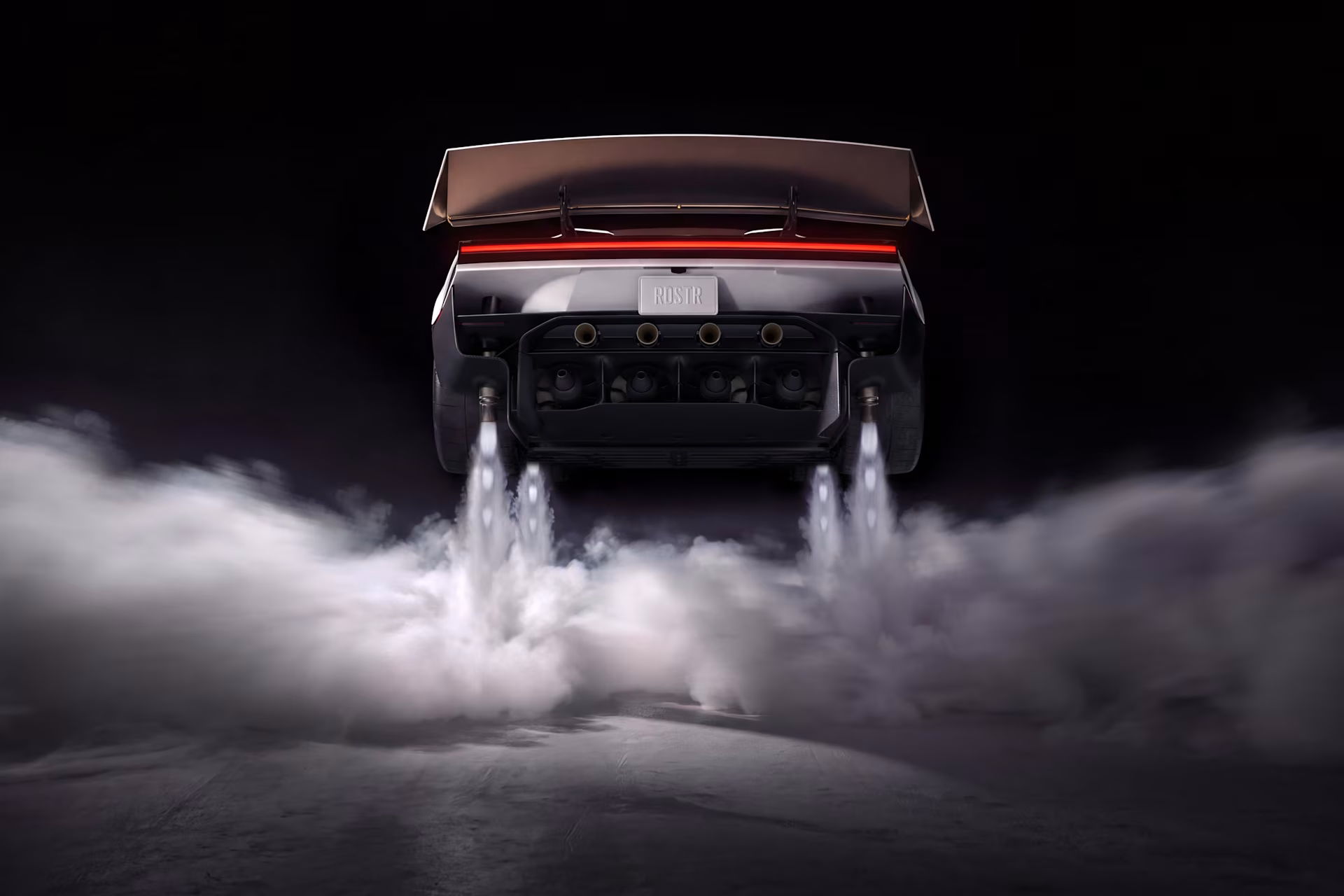
Elon Musk’s “flying” Roadster jumped and flipped through the air this month in a stunt that went viral around the world. But his bigger bet is on changing the way Tesla makes money—and the wider car industry is scrambling to catch up.
Five days after the spectacle, made possible by compressed-gas thrusters developed by Musk’s SpaceX, he revealed the companies were exploring a merger that could accelerate his push into autonomous driving.
At stake is more than a technological race. Car groups, already grappling with growing Chinese competition, are seeking to move beyond a business model centred on vehicle sales towards one that also generates recurring revenues from software and AI-powered services.
“Automakers are starting to look in the mirror and the software piece is what they are all looking at as the golden goose, because the margins are so high,” said Dan Ives, a tech analyst and partner at merchant bank Yorkville Ives.
Even with Tesla’s strategic shift in recent years, its car business remains a crucial cash cow for the group, where it generates 75 percent of total revenues and will be pivotal for the heavy spending Tesla will need to make in AI to compete with its Big Tech rivals.
But Musk faces a vastly different competitive environment from 2008, when Tesla launched its first battery-powered Roadster. Chinese rivals are now winning the electric vehicle race while also investing heavily in software and AI to mount a tech challenge in autonomous driving.
Against that backdrop, Musk’s earlier goal to sell 20 million vehicles a year by 2030 has been watered down to 5 million but even that is ambitious considering it only delivered 1.6 million last year.
Ars Video
What Happens to the Developers When AI Can Code? | Ars Frontiers
Analysts said the near-term key to driving Tesla’s growth to 5 million sales would be its “Full Self-Driving” software, which, despite its name, still requires humans to sit in the driver’s seat and pay full attention.
Although Tesla ceded its position as the world’s largest electric vehicle manufacturer to BYD last year, Musk has claimed his company remains ahead of Chinese competitors in autonomous technology.
“The biggest driver for demand is Full Self-Driving. And today, there’s really no competitor for FSD in any car that you can buy,” he said at an earnings briefing on Wednesday where the company revealed it had its largest car order backlog in four years.
The proportion of new Teslas sold in North America with the company’s supervised version of FSD reached more than 75 percent, while it now has 1.7 million active FSD subscriptions globally, up 67 percent from a year ago.
The company has not disclosed how much recurring revenue is generated by FSD, which is priced differently depending on market but costs $99 a month in the US.
However, Ives noted that the technology was already the highest-margin segment of Tesla’s business, with the potential to “transform the whole financial model” if it were to be expanded to about 50 percent of its global customer base from roughly 10-15 percent at present.
He argued that such an expansion would contribute more to the business than selling an extra 50,000-100,000 cars a year: “For every dollar of FSD revenue, the market rewards it 50-70 percent more than that dollar they would generate from selling an actual car.”
But realising that potential will depend on overcoming regulatory hurdles in multiple markets.
Tesla has yet to win any approval for its fully autonomous version of FSD.
Musk’s company and Volkswagen-backed Xpeng are in heated competition to win European approval for their advanced driver assistance and autonomous driving systems.
Tesla’s supervised version of FSD has been approved in the Netherlands and several other European countries but it is seeking wider EU backing to roll it out across the bloc through a vote of member states that has been delayed until December.
Xpeng is working with German authorities and is targeting EU approval for its FSD rival XNGP after the bloc adopts regulations on advanced driver assistance and autonomous driving, expected early next year. “We aim to be one of the first,” said Xpeng’s general counsel Zheng Yeqing.
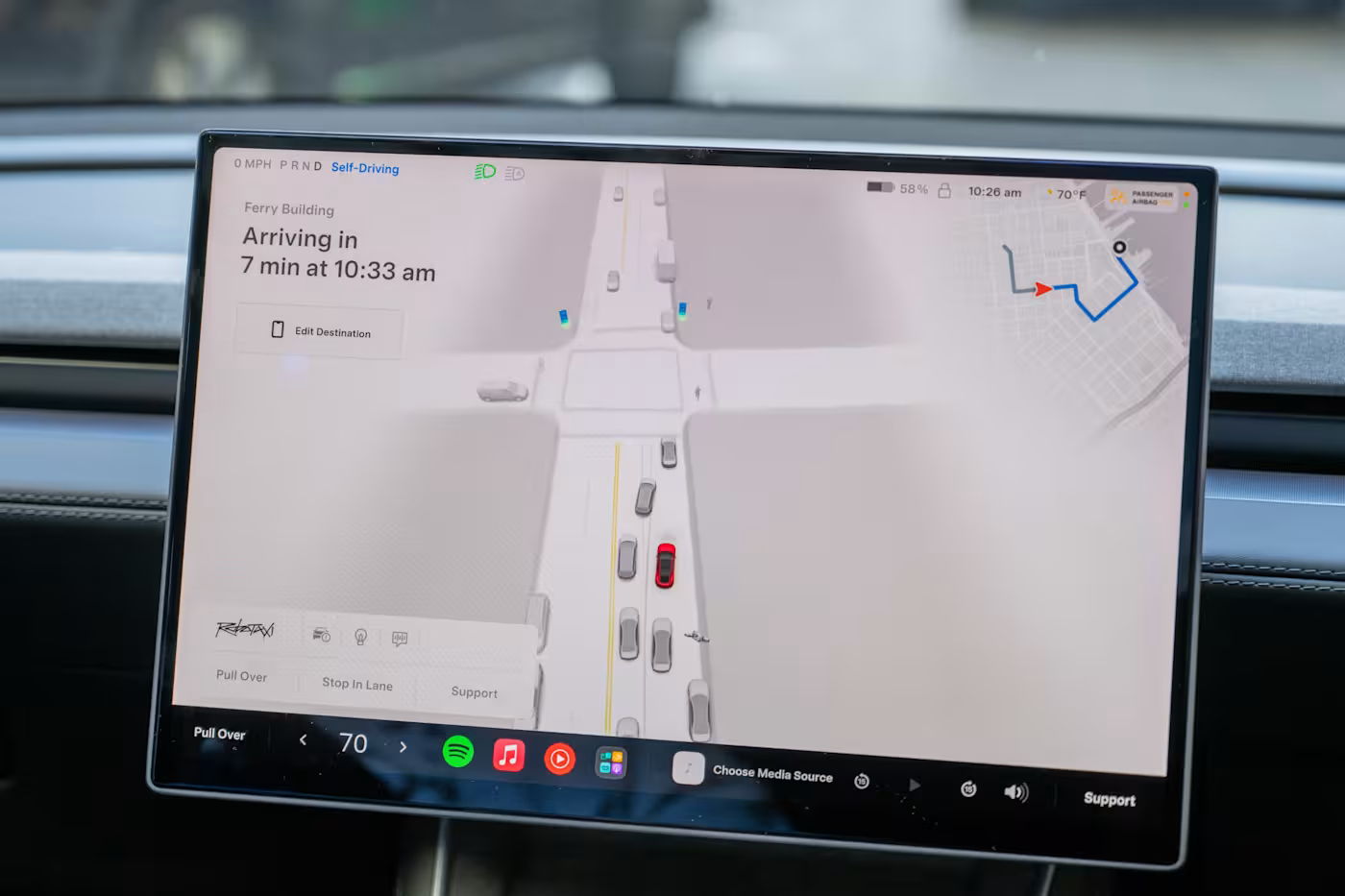
A visualisation of Tesla’s ‘"ull Self-Driving” software in August.
Credit: Smith Collection/Gado/Getty Images
A visualisation of Tesla’s ‘"ull Self-Driving” software in August. Credit: Smith Collection/Gado/Getty Images
As competition intensifies, a SpaceX merger could offer Tesla the firepower to take on Chinese rivals as well as big tech groups with far bigger AI budgets.
Combining the businesses would create an integrated company that could accelerate research into materials, AI and manufacturing while cutting costs and improving access to critical parts such as chips.
“You’re going to see the results of what happens when you have a collaboration with the world’s best car company and the world’s best rocket company,” Musk said at the flying Roadster event.
Lei Xing, founder of Chinese consultancy AutoXing, said “the future of mobility and vehicles will be autonomous, and autonomy will likely benefit from SpaceX tech.”
Evan Horetsky, a former Tesla executive and founder of industrial project developer Atlas Partners, said Chinese EV growth was “phenomenal and predicated on quick and full value chains of manufacturing—but don’t ever underestimate the Tesla team, always pushing technical boundaries in at least autonomy and robotics.”
One top 15 Tesla shareholder said he supported the merger, arguing that Tesla stood to benefit from “all the AI-related innovations now happening at SpaceX.”
The deal could also significantly increase Musk’s control over the businesses. According to William Blair analyst Jed Dorsheimer, the tie-up, if approved by shareholders and regulators, could allow Musk to control 50 percent or more of the merged entity.
But bringing the two businesses together could multiply existing risks.
“I think Elon Musk is playing a dangerous game,” said Max Willson, an industry observer and Tesla enthusiast. “SpaceX and Tesla have achieved extraordinary things, but combining his businesses risks tying their futures to his most speculative bets.”
“My concern is that trouble in AI could spread across the group, putting otherwise strong businesses at risk,” he added. “SpaceX’s success should be protected, not used to bankroll an ever wider set of ambitions.”
Whether or not the companies merge, Tesla’s technological ambition is already commanding the attention of traditional rivals.
The flying Roadster “certainly shows that even in the car world there’s a lot to do,” Ferrari’s chief executive Benedetto Vigna said at a recent automotive conference in Milan.
Tesla is already driving wider change in the industry. Like Musk’s company, China’s Xpeng, South Korea’s Hyundai and Japan’s Toyota are expanding their robotics businesses while General Motors and Ford in the US are pursuing new revenue from their energy storage businesses.
Autonomous driving in particular has become a major battleground for the global car industry as EVs with similar ranges and pricing proliferate.
Tom Narayan, an analyst at RBC Capital Markets, said Tesla was “a classic case of an innovator that disrupts and the other follows because they don’t want to be left behind.”
Among traditional carmakers, General Motors last year hired former Tesla executive Sterling Anderson to oversee the Detroit carmaker’s product development, with a mandate to develop a new generation of fully autonomous personal cars.
Other European carmakers such as BMW and Mercedes-Benz have also partnered with technology groups such as Qualcomm and Nvidia to bring a “Level 2 plus” driver assistance system, which requires active monitoring by a human driver behind the wheel.
“The leading carmakers today… are trying to reconsider their strategy completely,” said Igal Raichelgauz, chief executive of Israeli autonomous driving technology start-up Autobrains. He added that manufacturers wanted to move to a subscription model with a more advanced eyes-off technology to generate new revenue.
Volvo Cars chief executive Håkan Samuelsson acknowledged Tesla’s position as the frontrunner in autonomous technology.
“Tesla is probably leading the development in the west,” he told the FT, while claiming that Volvo was still firmly leading in software. “We will, together with Nvidia, develop our cars to be door-to-door automated and that will come in a new Volvo car pretty soon here.”
Additional reporting by Mari Novik in London.
© 2026 The Financial Times Ltd. All rights reserved Not to be redistributed, copied, or modified in any way.
Comments
 Loading comments...
Most Read
 1.Ice sheet expansion may have started 2,000 years ago, but we canceled that
- 2.Inside the Pentagon, the pressure is on to find a home for a new spaceport
- 3.NASA updates lander plans for Moon landings, finally solves long-festering Orion issue
- 4.Rocket Report: SpaceX says no thanks to military launches; Spanish rocket nearly ready
- 5.Crows can evaluate visual info twice as fast as mammals
Customize
Ars Technica has been separating the signal from the noise for over 25 years. With our unique combination of technical savvy and wide-ranging interest in the technological arts and sciences, Ars is the trusted source in a sea of information. After all, you don’t need to know everything, only what’s important.
More from Ars
Contact
Manage Preferences
© 2026 Condé Nast. All rights reserved. Use of and/or registration on any portion of this site constitutes acceptance of our User Agreement and Privacy Policy and Cookie Statement and Ars Technica Addendum and Your California Privacy Rights. Ars Technica may earn compensation on sales from links on this site. Read our affiliate link policy. The material on this site may not be reproduced, distributed, transmitted, cached or otherwise used, except with the prior written permission of Condé Nast. Ad Choices
Sign in dialog...
Sign in


来源:Ars Technica:AI · arstechnica.com